Blogs

Lorem ipsum dolor sit amet, consectetur adipiscing elit. Ut elit tellus, luctus nec ullamcorper mattis, pulvinar dapibus leo.

What If I Do the Wrong Exercise and Make My Back Worse?

This is one of the biggest fears for anyone with back pain.

And it is a valid fear.

Many people have had the experience of trying an exercise they were told was “good for back pain,” only to feel worse afterwards. They may have tried stretching, planks, sit-ups, yoga poses, reformer exercises, gym strengthening, or online routines, only to find that their pain increased.

The problem is not always the exercise itself.

The problem is often that the exercise was not right for that person’s specific back pain pattern.

Back pain is not one single condition. One person may feel worse after sitting. Another may feel worse after standing. Another may be aggravated by bending forward. Another may be irritated by arching backward. Another may have pain linked to poor hip mobility, weak lower abdominal control, locked knees, or poor walking mechanics.

So the question should not be:

“Is this exercise good for back pain?”

The better question is:

“Is this exercise right for my back, at this stage, with my current pain pattern?”

At the Menezes Method®, we do not begin with random exercises. We begin by identifying your specific back pain presentation.

That means looking at how you stand, sit, walk, bend, breathe, control your lower abdominals, and organise your spine.

Only then can the exercise be chosen intelligently.

Why the Wrong Exercise Can Aggravate Back Pain

An exercise may make symptoms worse if:

  • The spine is not stabilised before movement begins.
  • The lower back is gripping instead of being supported.
  • The hips are too stiff and the lumbar spine compensates.
  • The person is holding their breath.
  • The movement is too advanced.
  • The exercise loads the spine in the wrong direction.
  • The client pushes through warning pain.
  • The core is bracing instead of controlling.
  • The pelvis is moving when it should remain stable.
  • The exercise does not match the person’s pain trigger.

For example, a person with pain aggravated by spinal flexion may not respond well to repeated forward bending. A person with pain aggravated by compression may not tolerate prolonged standing or extension-based exercises. A person with poor lower abdominal control may feel their back grip during exercises that are supposed to strengthen the core.

This is why precision matters.

The Menezes Method® Approach

The Menezes Method® teaches that back pain exercise should follow a clear progression:

Assess first.
Stabilise second.
Control third.
Strengthen later.

Before making an exercise harder, the client must first learn how to control the spine, activate the correct lower abdominal support, breathe correctly, and move without increasing irritation.

This is where concepts such as Stable Spine and the B-Line® become essential.

Rather than simply telling someone to “strengthen the core,” we teach them how to support the lower spine with more precision.

The goal is not to work harder.

The goal is to work correctly.

What You Should Feel During Exercise

A safe exercise may create:

  • Gentle muscle work.
  • Mild stretch.
  • Improved awareness.
  • Light fatigue.
  • Better postural control.
  • Reduced stiffness.
  • A feeling of support.

An exercise should not create:

  • Sharp pain.
  • Increasing lower back pain.
  • Pain travelling down the leg.
  • Numbness or tingling.
  • Breath holding.
  • Lower back gripping.
  • Pain that remains worse after the session.
  • A feeling that you are forcing your body.

If an exercise increases your pain, it does not mean you have failed. It means your body is giving useful information.

The exercise may need to be modified, simplified, delayed, or replaced.

Key Message

If you are afraid of doing the wrong exercise, that fear should be respected.

The answer is not to avoid movement forever.

The answer is to learn which movement is right for your body.

With the right assessment, the right control, and the right progression, exercise can become a tool for recovery rather than another source of irritation.
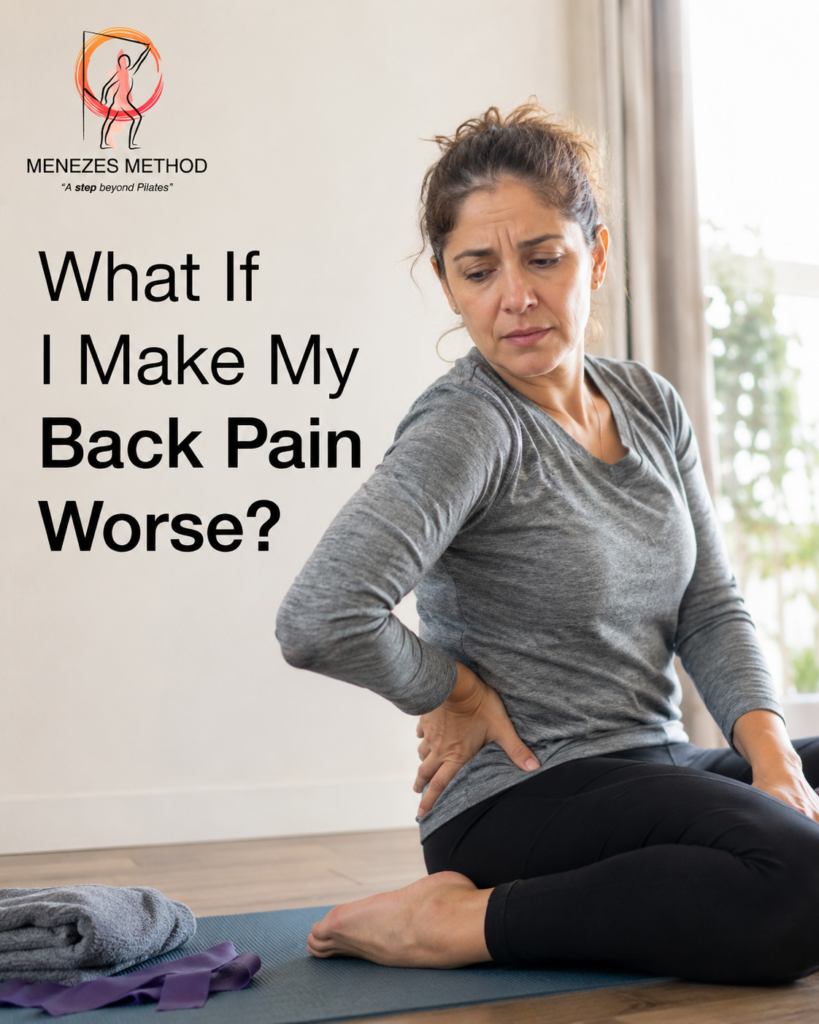
What If I Do the Wrong Exercise and Make My Back Worse?

This is one of the biggest fears for anyone with back pain.

And it is a valid fear.

Many people have had the experience of trying an exercise they were told was “good for back pain,” only to feel worse afterwards. They may have tried stretching, planks, sit-ups, yoga poses, reformer exercises, gym strengthening, or online routines, only to find that their pain increased.

The problem is not always the exercise itself.

The problem is often that the exercise was not right for that person’s specific back pain pattern.

Back pain is not one single condition. One person may feel worse after sitting. Another may feel worse after standing. Another may be aggravated by bending forward. Another may be irritated by arching backward. Another may have pain linked to poor hip mobility, weak lower abdominal control, locked knees, or poor walking mechanics.

So the question should not be:

“Is this exercise good for back pain?”

The better question is:

“Is this exercise right for my back, at this stage, with my current pain pattern?”

At the Menezes Method®, we do not begin with random exercises. We begin by identifying your specific back pain presentation.

That means looking at how you stand, sit, walk, bend, breathe, control your lower abdominals, and organise your spine.

Only then can the exercise be chosen intelligently.

Why the Wrong Exercise Can Aggravate Back Pain

An exercise may make symptoms worse if:

  • The spine is not stabilised before movement begins.
  • The lower back is gripping instead of being supported.
  • The hips are too stiff and the lumbar spine compensates.
  • The person is holding their breath.
  • The movement is too advanced.
  • The exercise loads the spine in the wrong direction.
  • The client pushes through warning pain.
  • The core is bracing instead of controlling.
  • The pelvis is moving when it should remain stable.
  • The exercise does not match the person’s pain trigger.

For example, a person with pain aggravated by spinal flexion may not respond well to repeated forward bending. A person with pain aggravated by compression may not tolerate prolonged standing or extension-based exercises. A person with poor lower abdominal control may feel their back grip during exercises that are supposed to strengthen the core.

This is why precision matters.

The Menezes Method® Approach

The Menezes Method® teaches that back pain exercise should follow a clear progression:

Assess first.
Stabilise second.
Control third.
Strengthen later.

Before making an exercise harder, the client must first learn how to control the spine, activate the correct lower abdominal support, breathe correctly, and move without increasing irritation.

This is where concepts such as Stable Spine and the B-Line® become essential.

Rather than simply telling someone to “strengthen the core,” we teach them how to support the lower spine with more precision.

The goal is not to work harder.

The goal is to work correctly.

What You Should Feel During Exercise

A safe exercise may create:

  • Gentle muscle work.
  • Mild stretch.
  • Improved awareness.
  • Light fatigue.
  • Better postural control.
  • Reduced stiffness.
  • A feeling of support.

An exercise should not create:

  • Sharp pain.
  • Increasing lower back pain.
  • Pain travelling down the leg.
  • Numbness or tingling.
  • Breath holding.
  • Lower back gripping.
  • Pain that remains worse after the session.
  • A feeling that you are forcing your body.

If an exercise increases your pain, it does not mean you have failed. It means your body is giving useful information.

The exercise may need to be modified, simplified, delayed, or replaced.

Key Message

If you are afraid of doing the wrong exercise, that fear should be respected.

The answer is not to avoid movement forever.

The answer is to learn which movement is right for your body.

With the right assessment, the right control, and the right progression, exercise can become a tool for recovery rather than another source of irritation.
Pilates for Men

The Ultimate Pilates, Fitness and Movement Theory Course