Table of Contents
- Why Menezes Pilates Is Effective for Shoulder Impingement
- How Menezes Pilates Supports Shoulder Function and Movement
- Scapular Stability Exercises for Shoulder Impingement
- Exercises to Avoid With Shoulder Impingement
- How Long Does Shoulder Impingement Take to Heal With Pilates?
- How Menezes Pilates Compares With Other Approaches
- Conclusion: Who Benefits and What to Expect
- Frequently Asked Questions
Last Updated: October 7, 2026
Why Menezes Pilates Is Effective for Shoulder Impingement
Shoulder impingement is one of the most common causes of shoulder pain in adults, and it rarely improves by simply resting the arm. Menezes Pilates is effective for shoulder impingement because it rebuilds the movement patterns, scapular control and rotator cuff strength that keep the joint centred, rather than just chasing the pain.
The shoulder is a shallow ball-and-socket joint that depends almost entirely on muscular control for stability. When the shoulder blade sits or moves poorly, the space under the acromion narrows and the tendons of the rotator cuff get compressed. That compression is what produces the classic painful arc, the pinch when you reach overhead, and the ache that wakes people at night.
Below, we break down how Menezes Pilates addresses that mechanism, which exercises help, which to avoid, realistic timelines, and how this approach compares with other care. This is general information, not a diagnosis, so any persistent shoulder pain deserves an assessment with a qualified health professional.
How Menezes Pilates Supports Shoulder Function and Movement
Menezes Pilates supports shoulder function by retraining the scapular and rotator cuff muscles that control the joint through range, rather than isolating the shoulder in isolation from the rest of the body. The shoulder blade is the moving platform the arm works from. If that platform is unstable, every overhead movement loads the tendons unevenly.
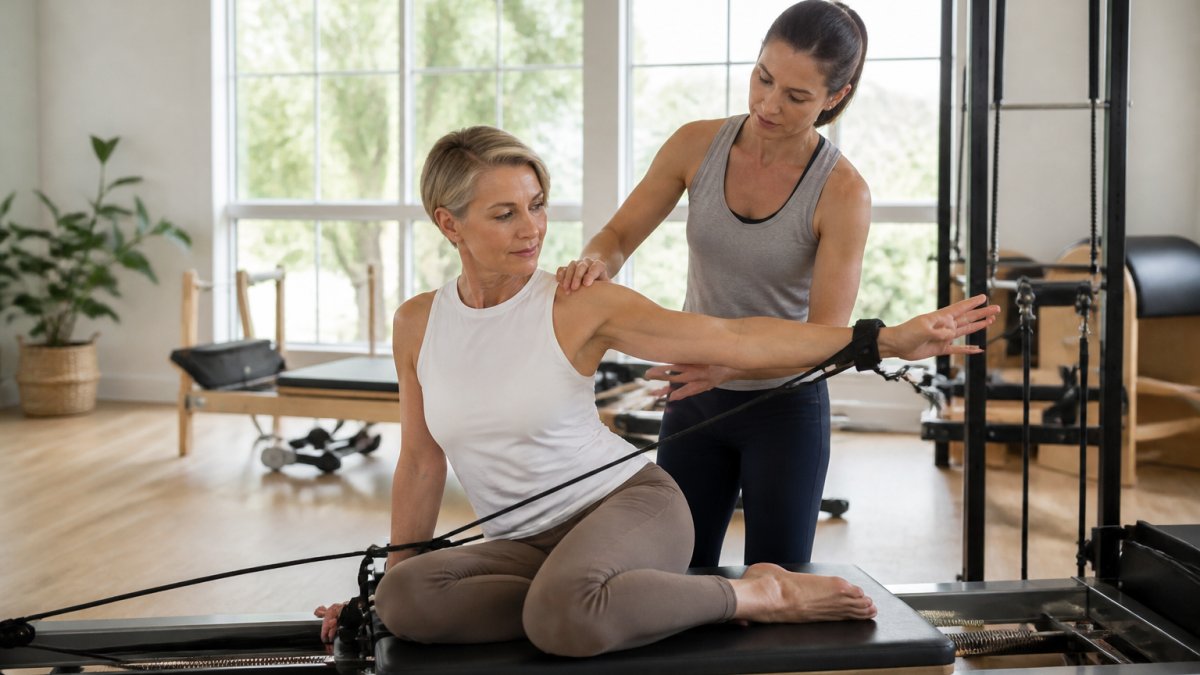
A typical session focuses on three things: scapular setting, thoracic mobility and graded loading of the rotator cuff. Poor thoracic extension forces the shoulder to compensate for range it cannot get from the spine, which is a common driver of impingement symptoms in desk-based workers. By restoring thoracic mobility and teaching controlled scapular movement, clinical Pilates reduces the demand placed on the shoulder joint itself.
Breathing matters here too. Learning to coordinate breath with core activation and spinal position changes how much unnecessary tension you carry through the neck and upper traps, which often overwork when the deeper stabilisers are not contributing.
Scapular Stability Exercises for Shoulder Impingement
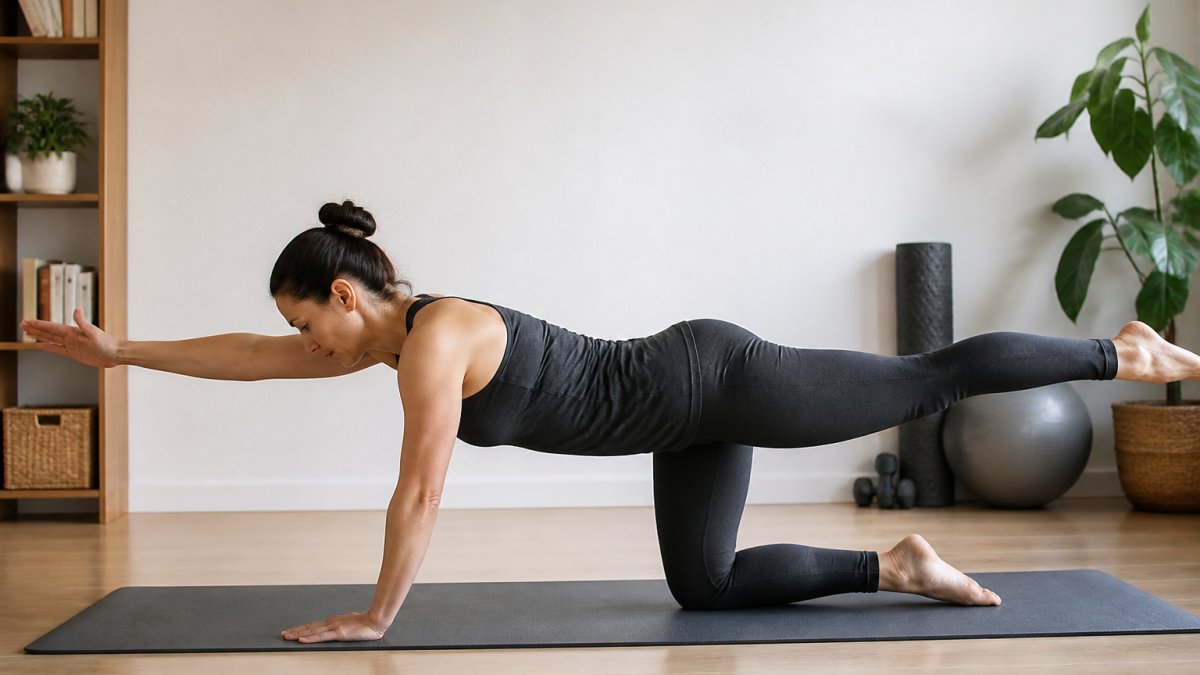
Scapular stability exercises for shoulder impingement target the muscles that control the shoulder blade: serratus anterior, lower trapezius and the rotator cuff. These are the muscles that keep the ball centred in the socket as the arm moves.
Effective options include:
- Scapular setting: gentle retraction and depression of the shoulder blade without shrugging the upper traps
- Serratus punches: reaching the arm forward against light resistance to activate serratus anterior
- Prone scapular lifts: small, controlled lifts that build lower trapezius endurance
- Rotator cuff rotations: controlled internal and external rotation with a light band or no load at all
- Closed-chain wall slides: sliding the forearms up a wall while keeping the shoulder blade controlled
The progression rule is simple: if a movement reproduces the pinch, reduce the range or the load. A common mistake is pushing into painful range because “no pain, no gain” sounds productive. With impingement, it usually makes the tendon more irritable.
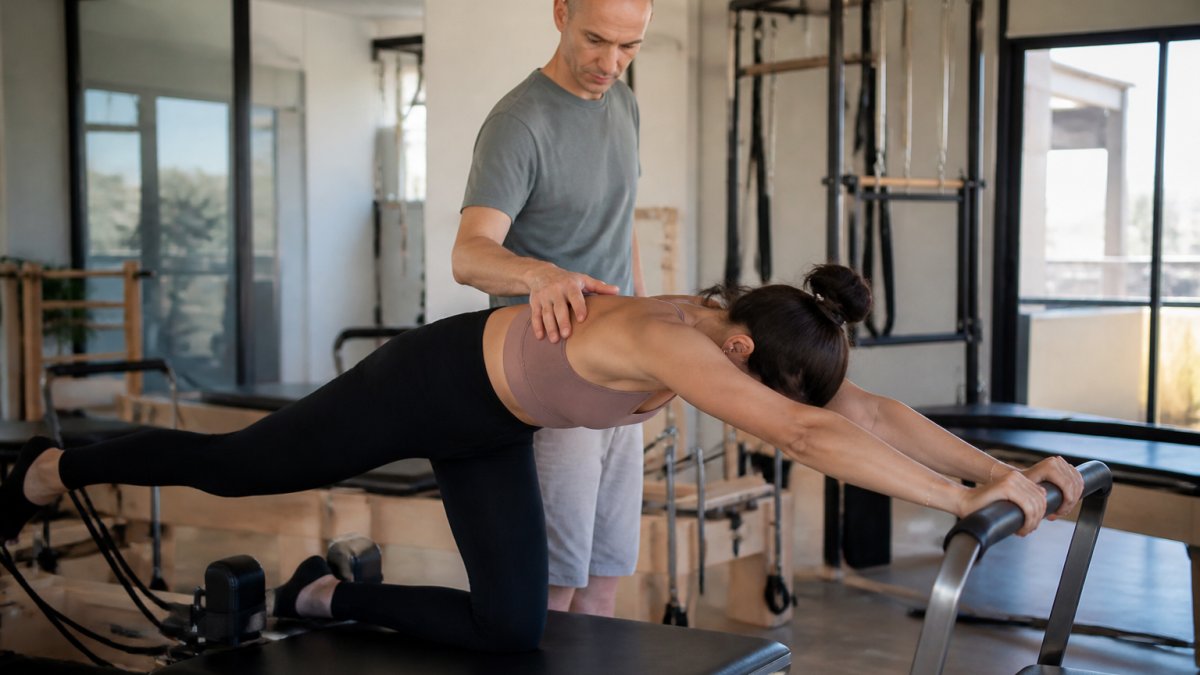
At Menezes Method Pilates, we use individual movement assessment to decide where each client starts. Two people with the same diagnosis often need very different starting points depending on their posture, thoracic mobility and daily habits.
Exercises to Avoid With Shoulder Impingement
Exercises to avoid with shoulder impingement are those that drive the arm into painful overhead or internally rotated positions under load while scapular control is still poor. The most common culprits are behind-the-neck presses, upright rows, wide-grip bench presses, and any heavy overhead press performed before the shoulder blade can upwardly rotate and posteriorly tilt through range.
The reason these movements aggravate impingement is mechanical, not moral. When the arm elevates, the subacromial space narrows unless the scapula rotates upward and tilts back to clear the acromion. If the lower trapezius and serratus anterior are not contributing, the humeral head migrates superiorly and the rotator cuff tendons and subacromial bursa get compressed.
That does not mean these movements are permanently off-limits. It means they are inappropriate while the tendon is irritable and control is poor. The useful test is symptom response: if a movement produces the pinch during or within a few hours after, it is currently too much.
Modified versions usually work better. A behind-the-neck press becomes a front raise with a neutral grip and reduced range. A wide-grip press becomes a narrower grip with the elbows tucked. A prone Y-raise can substitute for an overhead press while scapular upward rotation is rebuilt. The goal is to keep loading the shoulder in positions it can tolerate while the underlying control improves.
A common pattern practitioners see is that people avoid all overhead movement entirely, which then stiffens the joint and weakens the very muscles needed to restore clearance. The middle path is graded exposure: find the range where the shoulder moves without the pinch, load that range, and progressively expand it as symptoms settle. (Source: evidence supporting the effectiveness of Pilates for musculoskeletal conditions)
Signs that warrant assessment rather than self-management include pain that does not settle with rest, night pain that disrupts sleep for more than a week, weakness when lifting the arm, a feeling of instability or slipping, or any history of trauma. These features can indicate rotator cuff tears, labral involvement, or other pathology that needs a proper clinical examination before exercise progression continues.
BOOK YOUR FREE 15 MINUTE CONSULTATION →
How Long Does Shoulder Impingement Take to Heal With Pilates?
How long shoulder impingement takes to improve with Pilates depends on how long the problem has been present, how irritable the tendon is, and how consistently you practise. Many people notice reduced pain and easier movement within four to six weeks, with more meaningful strength and function returning over three to six months. These are typical ranges, not guarantees, and recovery is rarely linear.
It is worth being honest about the evidence. Most research on exercise for shoulder impingement relates to exercise therapy generally, progressive loading, scapular retraining, and rotator cuff strengthening, rather than clinical Pilates specifically. Clinical Pilates is one structured way to deliver those ingredients, with an emphasis on movement quality, breathing, and individualised progression.
What Menezes Pilates adds is the framework: a supervised, individualised progression that adjusts load and range based on symptom response, rather than a fixed set of exercises. That structure is what makes it useful for people who have flared up repeatedly with generic programs.
Rather than watching the calendar, track measurable outcomes. Useful markers include:
- Pain: average pain over the past week on a 0-10 scale, and how often it wakes you at night
- Range of motion: how far you can reach overhead or behind your back before the pinch appears
- Strength: how much resistance you can tolerate on external rotation and rowing without symptom flare
- Function: specific daily tasks such as reaching a high shelf, fastening a seatbelt, or carrying shopping
- Activity tolerance: how long you can perform a previously aggravating activity before symptoms return
Timelines vary widely. A recent, mild flare-up in an otherwise active person often settles faster than a chronic problem that has been building for years. Age, general fitness, sleep, and how much your daily activities aggravate the shoulder all influence recovery. Smoking and poorly controlled diabetes are also associated with slower tendon healing.
Progress is rarely linear. Good weeks and irritable weeks are normal. What matters is the trend over a month, not the trend over a day. If pain and function have not improved at all after six to eight weeks of consistent, supervised progression, that is a reasonable point to seek a review, either to reassess the diagnosis or to adjust the program.
How Menezes Pilates Compares With Other Approaches
Menezes Pilates combines the graded loading of physiotherapy-style rehabilitation with the movement quality and body awareness focus of Pilates. Where a general exercise class might build strength without addressing control, Menezes Pilates prioritises how the movement is performed.
Other approaches have their place. Manual therapy can reduce pain and improve range in the short term. Injection or surgical options are sometimes appropriate for specific cases. What clinical Pilates adds is a structured way to rebuild the movement patterns that contributed to the problem in the first place, so the issue is less likely to return.
| Approach | Primary Focus | Best For | Main Limitation |
|---|---|---|---|
| Clinical Pilates | Movement control and strength | Long-term function and recurrence | Requires consistent practice |
| Manual therapy | Pain and range | Short-term relief | Does not rebuild control alone |
| General exercise class | Fitness and strength | General conditioning | Not individualised |
| Injection or surgery | Structural or inflammatory | Specific presentations | Does not address movement patterns |
The strongest results usually come from combining approaches rather than choosing one exclusively. A conversation with your treating practitioner about what fits your situation is the sensible starting point.
Conclusion: Who Benefits and What to Expect
Menezes Pilates suits people with shoulder impingement who want to understand why their shoulder hurts and rebuild the movement patterns behind it, not just manage symptoms. It is not a quick fix, and it is not a substitute for medical assessment when pain is severe, persistent or accompanied by weakness or numbness.
At Menezes Method Pilates, our approach uses individual movement assessment, the B-Line, Stable Spine and SpinalCore concepts, and personalised exercise selection to address the specific patterns driving each person’s shoulder problem. Operating since 1986, we focus on quality of movement and long-term function rather than completing exercises for their own sake.
If your shoulder has been limiting your daily activities, book your free 15 minute consultation with Menezes Method Pilates and find out whether our approach fits your situation.
Frequently Asked Questions
How does Menezes Pilates differ from general Pilates for shoulder injuries?
Menezes Pilates uses individual assessment to identify your specific movement patterns, joint restrictions and muscle weaknesses before prescribing exercises. General Pilates classes follow a set routine for the whole group. With shoulder impingement, the difference matters because the same exercise can help one person and aggravate another depending on their scapular control, posture and range of motion. A clinical approach modifies and progresses exercises based on your symptom response, which is why it is better suited to rehabilitation than a one-size-fits-all class.
What exercises should I avoid with shoulder impingement?
Movements that repeatedly push the arm overhead or behind the body under load tend to aggravate impingement. These include overhead presses, upright rows, behind-the-neck pulldowns, deep bench presses and certain swimming strokes. You should also avoid any exercise that causes a sharp pinching sensation in the front of the shoulder. A qualified practitioner can assess which movements provoke your symptoms and provide safe alternatives that still build strength and mobility around the joint.
How long does shoulder impingement take to heal with Pilates?
Recovery timelines vary widely depending on how long you have had the problem, your age, tissue quality and how consistently you practise. Some people notice reduced pain and improved movement within four to six weeks of structured clinical Pilates. More significant functional gains, such as pain-free overhead reach or return to sport, often take three to six months. Your practitioner should reassess your progress regularly and adjust the program. If symptoms worsen or do not improve, seek a review with your doctor or physiotherapist.
What role does scapular control play in treating shoulder impingement?
The scapula provides a stable base for the shoulder joint to move on. When the scapular muscles are weak or poorly coordinated, the ball of the shoulder can drift upward and forward, narrowing the space where tendons pass and causing impingement. Menezes Pilates targets scapular stability through exercises that retrain the serratus anterior, lower trapezius and rotator cuff. Improving this control allows the shoulder to move through a fuller range without pinching, which is why scapular work is central to most impingement rehabilitation programs.