Table of Contents
- From Core Strength to Core Control: Why I Developed the Menezes Method®
- 1. What Core Control Really Means: A Menezes Method® Perspective
- True core control is not about having rock-hard abdominal muscles, holding your stomach in or performing endless sit-ups. It is about developing the ability to coordinate the muscles surrounding your spine and pelvis so that your body remains stable, supported and controlled during movement.
- Practical Core-Control Example: Getting Out of a Chair
- 2. Why Strong Abdominals Do Not Automatically Mean a Stable Spine
- 3. The B-Line®: Understanding and Controlling the Lower Abdominals
- What Exactly Is the B-Line®?
- Why Lower Abdominal Control Matters
- Practical Exercise: How to Find and Activate Your B-Line®
- The Difference Between B-Line® Activation and Abdominal Bracing
- Common Mistakes When Learning the B-Line®
- From the B-Line® to Functional Movement
- Why the B-Line® Is Central to the Menezes Method®
- The Menezes Method® Principle: Precision Before Power
- 4. Stable Spine® Versus Neutral Spine: Why Spinal Position Matters
- What Is Neutral Spine?
- Why I Question Rigid Neutral-Spine Teaching
- The Development of Stable Spine®
- Stable Spine® and the Natural Curves of the Spine
- Practical Menezes Method® Example: The Abdominal Curl
- Stable Spine® in Everyday Life
- Why Spinal Length Matters
- Stable Spine® and Back Pain
- The Menezes Method® Principle: Stability Without Rigidity
- 5. Ocean Breath: How Breathing Influences Core Control and Spinal Stability
- The Relationship Between the Diaphragm and Core Stability
- Why I Developed Ocean Breath
- Why the Exhalation Is Important
- Practical Exercise: Learning Ocean Breath
- Applying Ocean Breath to Pilates Exercises
- Ocean Breath and the Nervous System
- Common Breathing Mistakes in Pilates
- Stamina Stretch®: Extending the Breathing Principle
- Ocean Breath in Everyday Life
- The Menezes Method® Principle: Breathe to Move, Move to Breathe
- A Practical Core Control Assessment You Can Try
- Deep Core Muscle Activation: Finding the Right Muscles
- Breathing and Core Engagement: The Foundation of Control
- Core Stability Exercises for Everyday Movement
- How Long to Strengthen Your Core (and What Progress Looks Like)
- Common Mistakes and Safety Guidance
- Mind-Body Connection, Stress, and Movement Quality
- Frequently Asked Questions
Last Updated: October 9, 2026
From Core Strength to Core Control: Why I Developed the Menezes Method®
When I began teaching Pilates in the United Kingdom in the early 1980s, after training with Alan Herdman, I quickly understood that effective Pilates was about much more than developing strong abdominal muscles. It was about teaching the body to move with precision, stability and control.
My own experience with a lumbar disc injury at L4/L5 reinforced this understanding. I knew firsthand that strengthening the abdominal muscles was not necessarily the same as learning to protect and control the spine during movement.
When I established Australia’s first dedicated Pilates studio in 1986, I continued exploring how breathing, spinal positioning, muscle coordination and movement mechanics could be integrated into a more systematic approach.
Over the following decades, this work evolved into the Menezes Method®.
Central to my approach are several important principles:
B-Line®: A specific method of identifying and recruiting the lower abdominal region to support controlled movement.
Stable Spine®: An approach that emphasises spinal length, alignment and dynamic stability rather than forcing the spine into a rigid or artificially flattened position.
Ocean Breath: A coordinated breathing technique that encourages rhythmic respiration during exercise rather than unnecessary breath-holding.
Stamina Stretch®: A breathing and expansion approach incorporated into the broader system of movement control.
Foot Tripod: Establishing balanced contact through the foot to improve lower-limb alignment and provide a stable foundation for movement.
These principles are intended to work together. The aim is not simply to produce stronger muscles but to teach the body to coordinate those muscles effectively during everyday activities.
After four decades of teaching, I believe that developing core control is as much about how you move as it is about how strong you become.
— Allan Menezes, Founder, Menezes Method®
1. What Core Control Really Means: A Menezes Method® Perspective
True core control is not about having rock-hard abdominal muscles, holding your stomach in or performing endless sit-ups. It is about developing the ability to coordinate the muscles surrounding your spine and pelvis so that your body remains stable, supported and controlled during movement.
Drawing on more than 40 years of Pilates teaching experience, Allan Menezes developed the Menezes Method®, an approach that integrates precise muscle activation, spinal alignment, breathing and movement mechanics.
Central to this philosophy are the B-Line®, which provides a specific cue for lower abdominal activation, and Stable Spine®, which emphasises spinal length and dynamic stability rather than rigid positioning. Combined with Ocean Breath, these principles help teach the body to maintain control without unnecessary muscular tension.
Unlike conventional approaches that focus primarily on abdominal strength, the Menezes Method® treats core control as a coordinated, whole-body skill—one that supports better posture, more efficient movement and improved confidence in everyday activities.
The fundamental principle is simple: a strong core is valuable, but a well-controlled core is what makes that strength useful.
Practical Core-Control Example: Getting Out of a Chair
One of the simplest ways to understand core control is to observe how you get out of a chair. It is something we do many times every day, often without considering how our spine, pelvis and abdominal muscles work together.
Many people initiate the movement by rounding their lower back, throwing their upper body forward or pushing heavily through their arms. Although these strategies may get them standing, they can indicate that movement is being achieved through momentum rather than well-coordinated muscular control.
The Menezes Method® approach is different.
Begin by sitting towards the front of a firm chair, with your feet approximately hip-width apart and positioned comfortably beneath your knees. Establish your Foot Tripod, distributing pressure through the heel, the base of the big toe and the base of the little toe.
Next, gently activate your B-Line®, the lower abdominal control point located approximately 2–3 inches below your navel, towards the midline between the front pelvic bones. Rather than forcefully pulling your stomach in, think of establishing a subtle, controlled abdominal connection.
Now establish your Stable Spine®. Imagine lengthening your spine, creating space between your pelvis and ribcage without excessively arching or flattening your lower back.
As you prepare to stand, breathe in comfortably. Then, using the controlled exhalation of Ocean Breath, lean forward from your hips while maintaining spinal length and press evenly through your feet to rise into standing.
The objective is not to keep the spine rigid. It is to coordinate the movement of the hips, pelvis, spine and abdominal muscles without unnecessary tension or momentum.
Once standing, maintain your B-Line® connection and balanced Foot Tripod, allowing your body to achieve an upright posture without excessive muscular effort.
Now try the same movement without deliberately establishing your B-Line® or Stable Spine®. Notice whether your posture, balance, breathing or sense of control changes.
This simple exercise illustrates a fundamental principle of the Menezes Method®: core control is not something you practise only on a Pilates mat. It is a movement skill that can be incorporated into everyday life.
Whether you are getting out of bed, lifting shopping bags, climbing stairs or bending to pick something up, the aim is the same—to coordinate breathing, spinal stability and muscular activation so that movement becomes more efficient and controlled.
If rising from a chair produces pain, dizziness or instability, use appropriate support and seek individual assessment rather than forcing the movement.
2. Why Strong Abdominals Do Not Automatically Mean a Stable Spine
One of the greatest misconceptions in exercise and fitness is that strong abdominal muscles automatically produce a strong, stable spine. They don’t.
Over more than 40 years of teaching Pilates, I have worked with athletes, dancers, fitness enthusiasts and people suffering from chronic back pain. Some have arrived at my studio with impressive abdominal development, capable of performing countless sit-ups, crunches and demanding exercises. Yet many still struggle to maintain spinal stability during relatively simple movements.
Why?
Because abdominal strength and core control are not the same thing.
Strength Versus Control: Understanding the Difference
The abdominal muscles are an important part of the body’s muscular support system, but they do not work independently. They must coordinate with the diaphragm, pelvic floor, spinal stabilisers, hip muscles and the larger muscles responsible for movement.
The rectus abdominis, commonly known as the six-pack, is primarily responsible for flexing the trunk. The external and internal obliques assist with rotation, side bending and trunk stability. The transversus abdominis, the deepest abdominal muscle, contributes to abdominal wall tension and the regulation of intra-abdominal pressure.
Working alongside these muscles are the multifidus and other spinal muscles, which contribute to segmental control and stability.
All these muscles have important functions, but their effectiveness depends on how appropriately they work together during different movements.
A person may have exceptionally strong rectus abdominis muscles yet lack the coordination necessary to control the pelvis and lumbar spine when lifting a leg, bending forward or carrying a heavy object.
The problem is not necessarily insufficient strength. It may be how that strength is being used.
Why I Developed the B-Line®
In developing the Menezes Method®, I wanted to give people a more precise and repeatable way of understanding abdominal activation.
Generic instructions such as “tighten your stomach”, “brace your core” or “pull your navel towards your spine” can produce very different responses from one person to another.
Some people contract excessively, hold their breath or unnecessarily tense their shoulders and neck. Others have difficulty distinguishing lower abdominal engagement from movement of the pelvis or ribcage.
This led me to develop the B-Line®, a specific teaching cue centred on the lower abdominal region, approximately 2–3 inches below the navel, in the midline between the anterior pelvic bones.
The objective is to develop awareness and controlled recruitment of the abdominal muscles without excessive bracing, breath-holding or distortion of spinal positioning.
The B-Line® is not intended to represent a separate anatomical muscle or a magical switch that isolates the deep abdominals. Rather, it provides a practical reference point through which students can learn to coordinate abdominal activity with breathing and movement.
Once a student understands this connection, I introduce increasingly demanding exercises while encouraging them to maintain the appropriate level of control.
Stable Spine®: Why Spinal Position Matters
Abdominal activation alone is not sufficient if the spine is poorly positioned or movement is inadequately controlled.
This is where my Stable Spine® principle becomes particularly important.
Throughout my teaching career, I have observed people attempting to stabilise their backs by rigidly flattening the lumbar spine, forcefully tucking the pelvis or holding themselves in what they believe to be a perfect neutral position.
Although different spinal positions can be appropriate for different exercises, I believe excessive rigidity can interfere with natural, coordinated movement.
Stable Spine® emphasises spinal length, appropriate alignment and controlled movement rather than forcing the spine into one fixed shape.
Imagine the spine being gently lengthened between the pelvis and the head. The abdominal muscles provide support while the spinal muscles work in coordination with them.
This does not mean the spine should never flex, extend or rotate. Those movements are essential to normal function.
The objective is to develop the strength, mobility and coordination necessary to move through an appropriate range while managing the forces acting on the spine.
A stable spine is not necessarily a motionless spine. It is a spine whose movement can be appropriately controlled.
The Role of Breathing in Spinal Stability
Another mistake I frequently encounter is excessive breath-holding during abdominal exercises.
Breathing and spinal stability are mechanically connected. The diaphragm contributes not only to respiration but also to the regulation of intra-abdominal pressure, working alongside the abdominal wall and pelvic floor.
For this reason, breathing is an integral part of the Menezes Method®.
Through Ocean Breath, I teach coordinated inhalation and exhalation that can be integrated with abdominal activation and controlled movement.
My preferred teaching rhythm is generally a four-count inhalation followed by a six-count exhalation, adjusted to the exercise and the individual’s capabilities.
Rather than relying on maximum muscular tension, I want students to learn how much activation is actually required for the task.
Importantly, breath-holding and stronger abdominal bracing can be appropriate in certain high-load activities. My concern is with their unnecessary use during exercises intended to develop refined control and coordination.
Practical Core-Control Example: The Supine Leg Lift
A simple way to appreciate the difference between abdominal strength and core control is to lie on your back and slowly lift one leg.
Begin with both knees bent, feet flat on the mat and arms resting comfortably beside your body.
Establish your B-Line® and gently lengthen your spine into your Stable Spine® position. Avoid forcefully pressing your lower back into the mat or exaggerating the lumbar arch.
Take a comfortable breath in. As you slowly exhale, lift one foot a few centimetres from the mat, keeping the knee bent.
Observe what happens to your pelvis and lower back.
Does your pelvis tilt or rotate? Does your lower back change position unexpectedly? Do you hold your breath or tense your neck and shoulders?
Lower the foot with control, then repeat with the opposite leg.
Try the exercise again, this time concentrating on maintaining your B-Line®, spinal length and coordinated breathing.
The goal is not to prevent every small movement of the spine or pelvis. It is to recognise and control unwanted movement without excessive effort.
If you cannot maintain comfortable control, reduce the height of the lift or simply slide one heel along the mat instead.
This deceptively simple exercise can reveal coordination challenges that may go unnoticed during more demanding abdominal exercises.
It is an observation of movement quality, not a diagnostic test for weakness or a particular spinal condition.
The Menezes Method® Philosophy: Control Before Intensity
In today’s fitness industry, progress is frequently measured by heavier resistance, more repetitions, faster movements or greater muscular fatigue.
But in Pilates, I believe progress must also be measured by the quality of movement.
Can you maintain appropriate spinal control as the exercise becomes more demanding? Can you coordinate breathing with abdominal activation? Can you move your arms and legs without unnecessary compensation?
And, most importantly, can you apply those skills to everyday life?
This is why the Menezes Method® places such importance on establishing movement foundations before introducing greater complexity or resistance.
After four decades of teaching, my guiding principle remains: strength is important, but strength without appropriate control does not guarantee spinal stability.
The objective is not simply to build stronger abdominal muscles. It is to teach the body how to use them effectively, efficiently and intelligently.
3. The B-Line®: Understanding and Controlling the Lower Abdominals
One of the most important principles I developed in the Menezes Method® is the B-Line®, a simple but highly effective teaching concept designed to help people understand and develop conscious control of their lower abdominal muscles.
During my decades of teaching Pilates, I have observed that many people struggle to identify exactly which muscles they should be activating when instructed to “engage the core.”
Some pull their stomach in forcefully. Others push their abdominals outward, hold their breath, tuck their pelvis or tighten their buttocks. Although these actions may create a sensation of muscular effort, they do not necessarily produce the coordinated abdominal control required for efficient movement.
This is why I developed the B-Line®.
Rather than giving students vague instructions to tighten their stomach muscles, the B-Line® provides a specific anatomical reference point and a practical method of developing awareness, coordination and control.
What Exactly Is the B-Line®?
The B-Line® is located in the lower abdominal region, approximately 2–3 inches (5–7.5 cm) below the navel, towards the midline between the two anterior superior iliac spines (ASIS)—the prominent bony landmarks at the front of the pelvis.
It serves as a teaching reference for the controlled recruitment of the lower abdominal region, particularly the transversus abdominis and its coordination with the other abdominal and spinal stabilising muscles.
The transversus abdominis is the deepest of the abdominal muscles. Its fibres run predominantly horizontally around the abdominal wall, contributing to abdominal tension and intra-abdominal pressure.
It functions in coordination with the internal and external obliques, diaphragm, pelvic floor and spinal musculature.
It is important to understand that the B-Line® is not a separate anatomical muscle. It is a specific Menezes Method® teaching cue designed to help students identify and regulate abdominal activation.
The objective is not to generate the strongest possible contraction. It is to develop sufficient muscular engagement to support the movement being performed.
Why Lower Abdominal Control Matters
The lumbar spine consists of five vertebrae, supported by intervertebral discs, ligaments and a complex system of muscles.
The lower lumbar region, particularly the L4/L5 and L5/S1 segments, is subjected to substantial forces during everyday activities such as bending, lifting, sitting and standing.
Abdominal muscles contribute to the management of these forces by working with the spinal muscles to regulate trunk movement and stiffness.
However, muscular strength alone does not guarantee that the spine will be appropriately controlled.
A person may be able to perform dozens of abdominal curls yet struggle to control pelvic movement while lifting one leg from the floor.
This is where the B-Line® becomes particularly useful as a teaching tool.
By developing awareness of lower abdominal recruitment, students can begin to coordinate muscular activity with spinal positioning, breathing and limb movement.
For me, this is the foundation of effective Pilates training.
Practical Exercise: How to Find and Activate Your B-Line®
The following exercise introduces one of the fundamental concepts of the Menezes Method®.
Step 1: Establish your starting position
Lie comfortably on your back with your knees bent and your feet resting flat on the mat, approximately hip-width apart.
Allow your shoulders and neck to relax.
Position your pelvis comfortably and imagine gently lengthening your spine rather than forcefully flattening your lower back.
Step 2: Locate your B-Line®
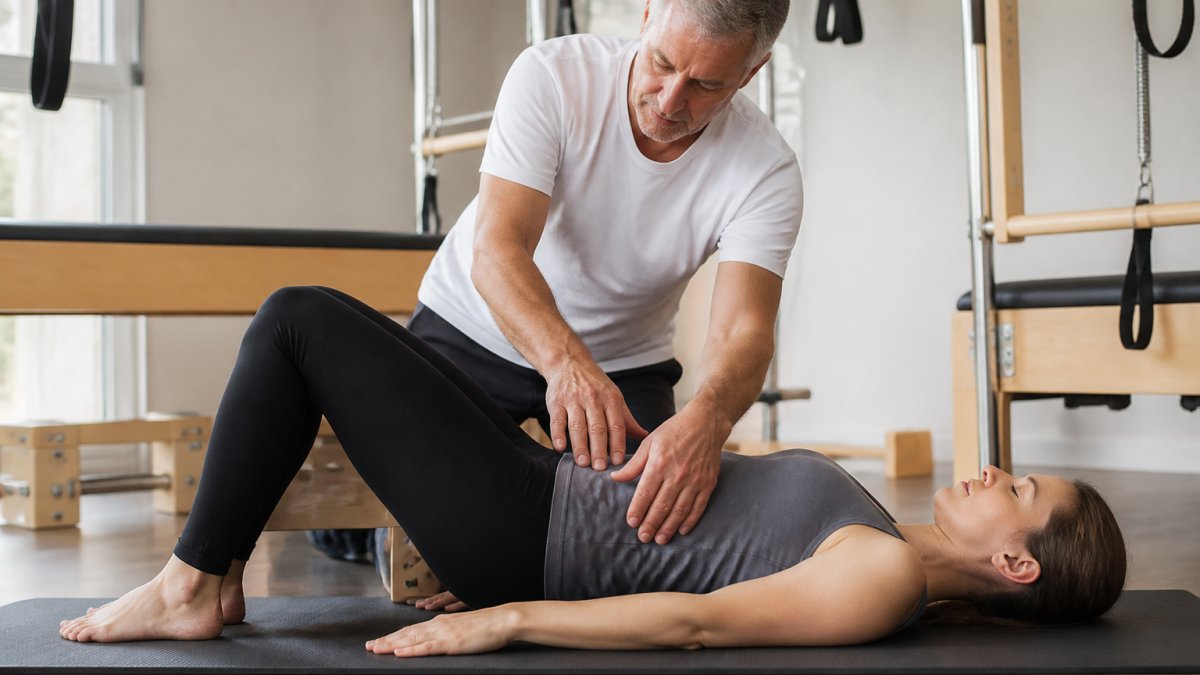
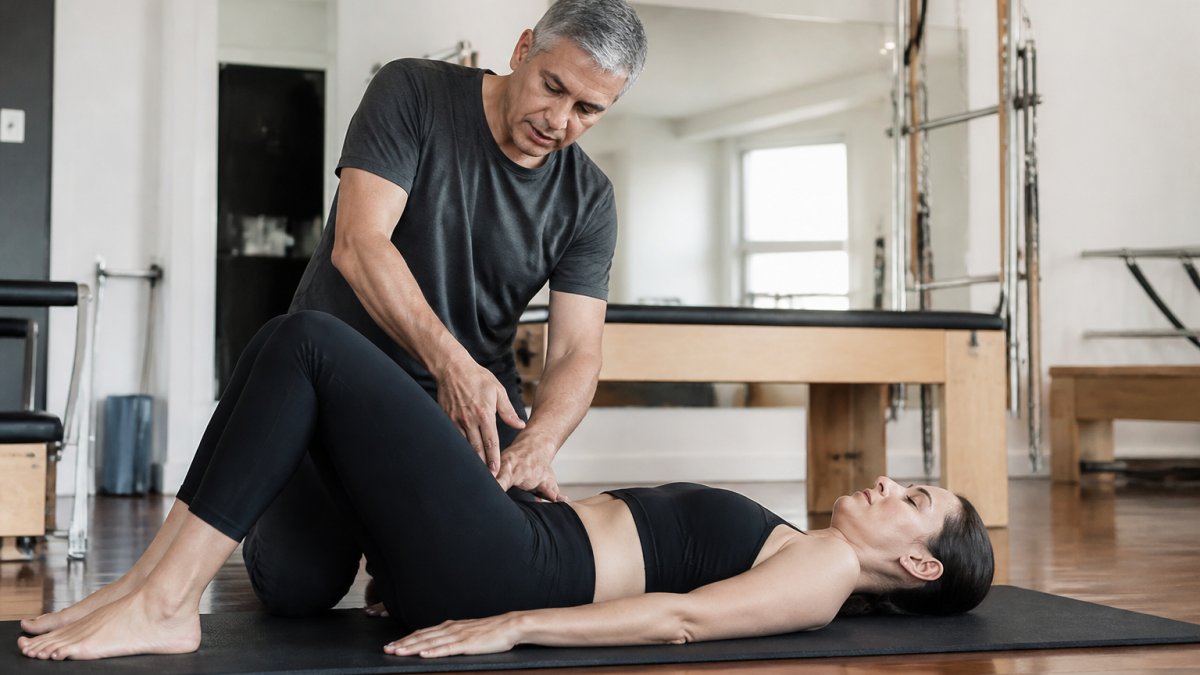
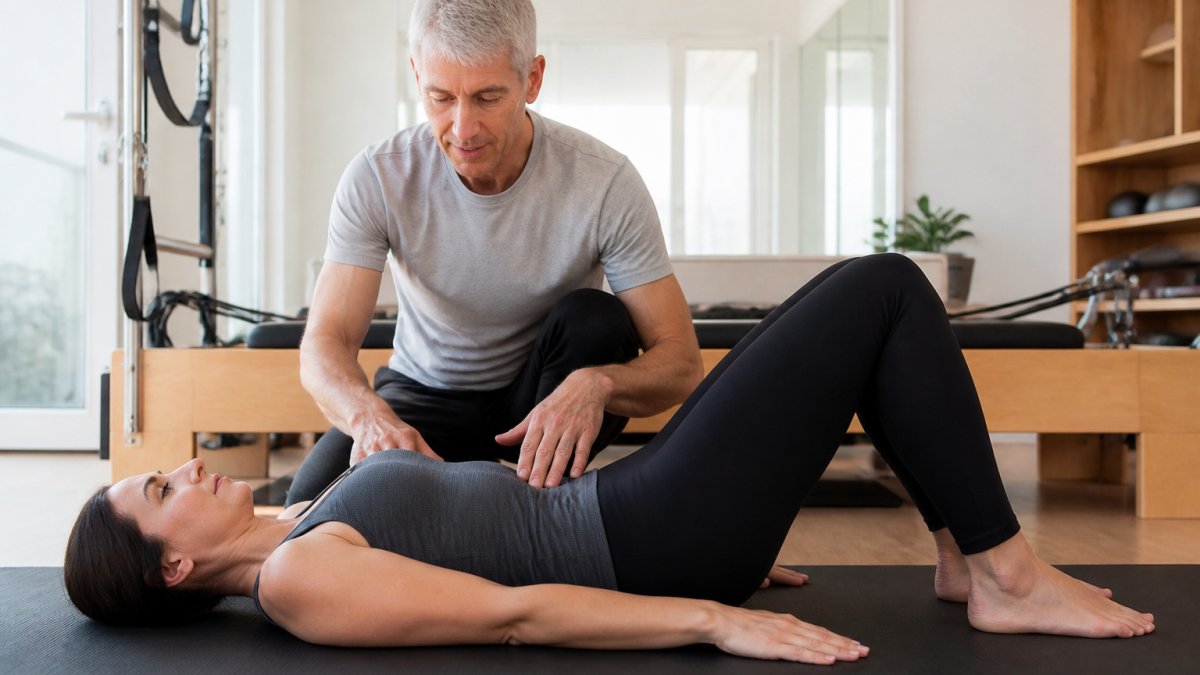
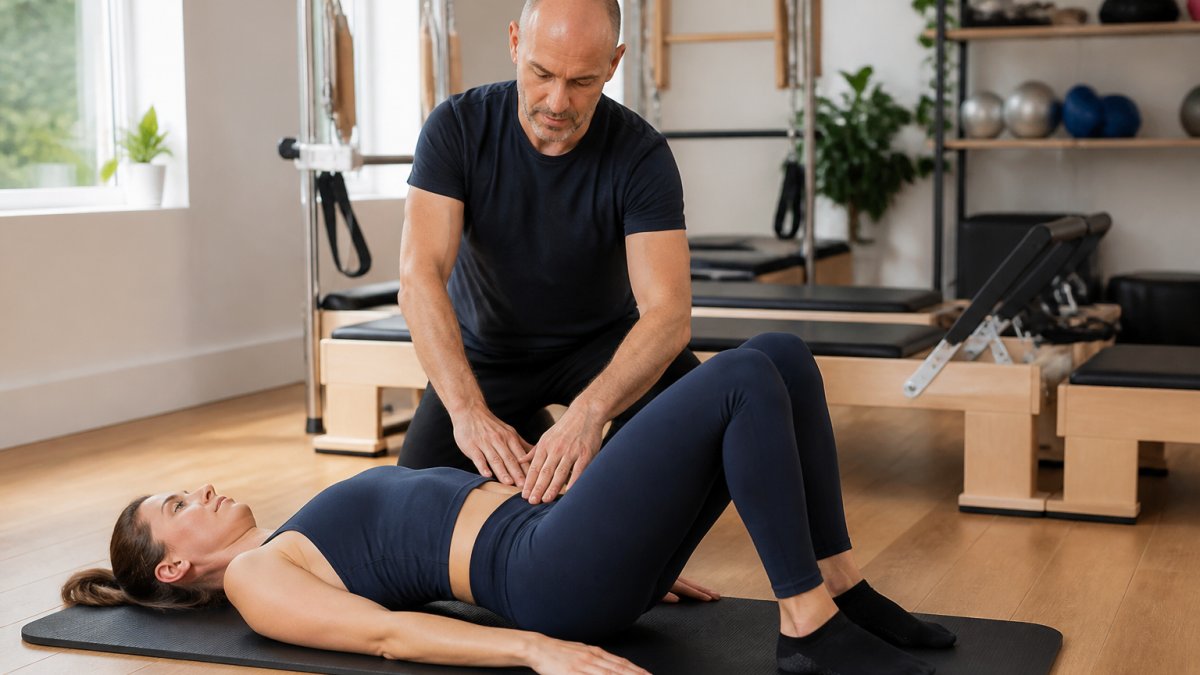
Place your fingertips on the lower abdominal region, approximately 2–3 inches below your navel.
Identify the central region between the two front pelvic bones.
This is your B-Line® reference area.
Step 3: Establish gentle abdominal activation
Without moving your pelvis or holding your breath, gently draw the lower abdominal wall inward.
Think of creating a subtle connection across the lower abdominal region rather than forcefully sucking your stomach in.
You should be able to maintain this gentle activation while breathing comfortably.
The objective is awareness and control—not maximum tension.
Step 4: Introduce Ocean Breath
Inhale comfortably through your nose for approximately four counts.
Allow your ribcage to expand naturally.
Exhale slowly for approximately six counts while maintaining appropriate B-Line® engagement.
Avoid gripping your abdominal muscles, lifting your shoulders or tightening your neck.
Repeat for five to ten comfortable breathing cycles.
If the breathing rhythm feels forced, shorten the counts.
Step 5: Maintain control during movement
Once you can establish your B-Line® comfortably, slowly slide one heel along the mat to straighten the leg.
Keep the pelvis reasonably stable and avoid unnecessary movement through the lower back.
Return the heel to its starting position, then repeat with the opposite leg.
The challenge is not the size of the movement but your ability to coordinate abdominal activation, spinal positioning and breathing throughout it.
The Difference Between B-Line® Activation and Abdominal Bracing
Traditional exercise instruction frequently uses the terms bracing, drawing in and core activation interchangeably, but they describe different strategies.
Abdominal bracing generally involves increasing muscular tension around the trunk, often to improve stiffness when resisting external forces.
Abdominal drawing-in is commonly used to encourage awareness and recruitment of the deeper abdominal wall.
Both strategies have legitimate applications. Neither should be considered universally correct or incorrect.
The B-Line® is my method of teaching people to become more aware of their lower abdominal region and to regulate their activation according to the exercise.
I do not want students unnecessarily gripping their abdominals throughout an entire session.
Instead, I want them to develop the ability to increase or reduce muscular engagement as the demands of movement change.
The objective is controlled activation, not constant contraction.
Common Mistakes When Learning the B-Line®
One of the most frequent errors is pulling the abdominal wall inward so forcefully that normal breathing becomes difficult.
Another is automatically tilting the pelvis backwards and pressing the lumbar spine into the mat.
Others compensate by tightening the buttocks, clenching the jaw or lifting the shoulders.
These compensations can distract from the intended exercise and make it difficult to develop refined muscular control.
I encourage students to begin with a gentle contraction, observe how their body responds and gradually introduce movement.
If the neck, shoulders or hip flexors become excessively tense, reduce the intensity and reassess the starting position.
The aim is to make the exercise more precise, not more strenuous.
From the B-Line® to Functional Movement
Once students understand their B-Line®, they can begin applying it to more complex Pilates exercises.
For example, during a supine leg movement, the lower abdominal muscles work with the spinal stabilisers to help control the position of the pelvis.
During a controlled abdominal curl, the B-Line® cue helps students remain aware of the lower abdominal region as the trunk moves into flexion.
During standing exercises, abdominal activation must be coordinated with the hips, legs and feet.
This is particularly important when teaching movements involving balance, rotation or resistance.
The level of abdominal activation will vary according to the task. A gentle leg slide requires a different muscular response from lifting a heavy object.
The skill is learning to recognise and regulate that difference.
Why the B-Line® Is Central to the Menezes Method®
My personal experience with an L4/L5 disc injury played an important role in shaping my approach to Pilates and spinal control.
Having experienced persistent back pain myself, I became particularly interested in how spinal positioning, abdominal coordination and movement technique could influence comfort and function.
Over subsequent decades, I incorporated these observations into the development of the Menezes Method®.
The B-Line® became one of its central teaching principles because it provides students with a practical starting point for developing body awareness and movement control.
It is not a claim that one abdominal muscle can independently protect the spine, nor that simply activating the B-Line® can cure back pain.
Back pain is complex and may involve physical, neurological, psychological and lifestyle factors.
Instead, the B-Line® is one element of a broader teaching system that combines abdominal coordination, Stable Spine®, Ocean Breath, mobility and progressive strengthening.
The Menezes Method® Principle: Precision Before Power
In Pilates, I believe it is essential to understand a movement before attempting to make it harder.
The B-Line® gives students a starting point for developing that understanding.
By learning to recognise appropriate lower abdominal activation and coordinate it with breathing and spinal movement, they establish a foundation that can be developed through progressively more demanding exercises.
This is not about keeping the stomach pulled in all day or maintaining permanent muscular tension.
It is about developing a skill that can be used when needed.
After 40 years of teaching Pilates, I continue to emphasise a fundamental principle: effective core control is not determined by how hard you contract your abdominal muscles, but by how precisely you coordinate them with the rest of your body.
That is the purpose of the B-Line®, and one of the foundations of the Menezes Method.
4. Stable Spine® Versus Neutral Spine: Why Spinal Position Matters
One of the most significant differences between the Menezes Method® and many contemporary approaches to Pilates is how we teach spinal positioning and stability.
Throughout my more than 40 years of teaching, I have observed considerable confusion surrounding the concept of neutral spine. Students are frequently instructed to maintain a neutral position throughout exercises, often without understanding what that means or whether it is appropriate for the movement they are performing.
I believe this approach can become problematic when neutral spine is treated as a rigid position that must be maintained regardless of the exercise.
This is one of the reasons I developed Stable Spine®, a fundamental principle of the Menezes Method® that emphasises spinal length, muscular coordination and controlled movement rather than simply holding the spine in a predetermined position.
My philosophy is straightforward: the spine needs both stability and mobility. Neither should be sacrificed unnecessarily for the other.
What Is Neutral Spine?
Neutral spine generally refers to a spinal position that preserves the natural curves of the vertebral column without excessive flexion or extension.
In the lumbar region, this usually means maintaining a degree of the natural inward curve, known as lumbar lordosis.
The concept has legitimate applications in rehabilitation, strength training and exercise instruction.
However, problems can arise when neutral spine is taught as the only correct position for every exercise.
During the 1990s, research into spinal stability, particularly work associated with Australian physiotherapists including Professor Paul Hodges and Dr Carolyn Richardson, helped popularise approaches involving deep abdominal muscle activation and lumbar stabilisation.
These developments influenced physiotherapy and subsequently Pilates teaching internationally.
Although this research made important contributions to our understanding of trunk muscle function, the practical application of spinal stabilisation concepts has sometimes become oversimplified.
In some Pilates environments, students are encouraged to maintain a neutral lumbar curve even while performing movements that naturally require spinal flexion.
In my experience, this can create unnecessary muscular tension or disrupt the coordination of the movement.
Why I Question Rigid Neutral-Spine Teaching
Consider a simple abdominal curl performed while lying on your back.
The objective is to lift the head, shoulders and upper trunk from the mat through controlled spinal flexion.
Yet some students are instructed to preserve their lumbar lordosis throughout the movement.
This can create a conflict between the intended action of curling the trunk and the instruction to maintain a fixed lumbar position.
The rectus abdominis and oblique muscles contribute to spinal flexion, while the hip flexors can influence pelvic and lumbar positioning.
If the student attempts to curl forward while rigidly maintaining lumbar extension, the movement may become concentrated in the upper trunk, potentially increasing unnecessary neck or hip-flexor effort.
It is important to distinguish this from saying that neutral spine itself is harmful. There is no convincing evidence that a neutral lumbar position universally causes back pain or injury.
My concern is with rigidly enforcing a spinal position when it is inappropriate for the movement or the individual.
This distinction is central to how I teach Pilates.
The Development of Stable Spine®
When I began developing the Menezes Method®, I wanted students to understand that spinal stability should not be confused with spinal rigidity.
My own experience with an L4/L5 disc injury had made me particularly aware of how different spinal positions and movement strategies could influence symptoms.
Through years of observing and teaching students with varying abilities, I developed Stable Spine® as a practical approach to coordinating spinal positioning with abdominal control and movement.
The principle emphasises creating a sense of length through the vertebral column, establishing appropriate abdominal support through the B-Line® and allowing movement to occur with deliberate muscular control.
I frequently use the image of gently lengthening the spine, as though creating space between the pelvis and the head.
This is a teaching cue rather than a claim that muscles can physically separate the vertebrae or decompress damaged discs.
The intention is to discourage unnecessary compression through muscular gripping, excessive arching or forced flattening and to encourage better awareness of spinal alignment.
Stable Spine® is not about freezing the spine in place. It is about maintaining appropriate control as the spine and limbs move.
Stable Spine® and the Natural Curves of the Spine
The spine is not a straight column.
It contains natural curves that contribute to its ability to manage loads and accommodate movement.
The cervical and lumbar regions generally curve inward, while the thoracic spine curves outward.
These curves change during everyday activities.
When we bend forward, spinal flexion occurs. When we reach overhead or look upward, extension may occur. When we turn to look behind us, the spine rotates.
These are normal movements.
The Menezes Method® does not attempt to eliminate them.
Instead, I teach students to understand where movement is occurring, how their muscles are contributing and whether the movement is appropriate for the task.
In some exercises, maintaining a relatively stable lumbar position is desirable while the hips or shoulders move.
In others, controlled spinal flexion, extension or rotation is an essential part of the exercise.
The objective is not to impose one universal spinal position but to develop the ability to control different positions safely and effectively.
Practical Menezes Method® Example: The Abdominal Curl
A useful illustration of the Stable Spine® principle is the supine abdominal curl.
Begin lying on your back with your knees bent and your feet flat on the mat.
Allow your shoulders to relax and establish awareness of your B-Line®.
Imagine lengthening your spine, avoiding excessive arching or forcefully pressing the lower back into the mat.
Take a comfortable breath in.
As you exhale, gently nod your head and begin curling your upper trunk away from the mat.
Allow the spine to move progressively into flexion rather than attempting to preserve a rigid lumbar arch.
The movement should be initiated and controlled through the abdominal muscles, with the head following the movement of the trunk rather than being pulled forward by the neck.
Avoid thrusting the chin towards the chest or using momentum to lift the shoulders.
Only curl as far as you can comfortably maintain control.
Pause briefly, then lower your spine with control.
Throughout the exercise, maintain awareness of your B-Line® and coordinate breathing with movement.
A small, well-controlled curl is preferable to a larger movement achieved through neck strain or excessive hip-flexor effort.
This example illustrates an important point: spinal stability does not necessarily mean preventing spinal movement.
It means controlling that movement appropriately.
Students with acute back pain, osteoporosis, vertebral fractures or conditions aggravated by spinal flexion may require modification or a different exercise entirely.
Stable Spine® in Everyday Life
The application of Stable Spine® extends far beyond Pilates exercises.
Consider lifting a shopping bag from the floor.
Some people automatically round their backs, while others rigidly arch their lumbar spines in an attempt to maintain what they perceive as perfect posture.
Neither strategy is necessarily appropriate in every circumstance.
The important considerations include the weight of the object, its distance from the body, the available movement at the hips and spine, and the person’s strength and capacity.
Through the Menezes Method®, I encourage students to coordinate their B-Line®, breathing and spinal control while selecting an appropriate movement strategy.
Sometimes this involves bending primarily through the hips and knees while maintaining a relatively stable trunk.
At other times, controlled spinal movement is perfectly normal.
The same principle applies when getting out of bed, reaching for an object, climbing stairs or lifting a child.
Rather than teaching people to fear spinal movement, I want them to develop confidence in their ability to control it.
Why Spinal Length Matters
One of the central teaching cues in Stable Spine® is the sensation of spinal length.
When students are asked to strengthen their abdominals, some respond by compressing the trunk, excessively flexing the lumbar region or gripping through the hip flexors.
By introducing a sense of length, I encourage them to avoid unnecessary collapse through the trunk while maintaining appropriate muscular support.
This can be particularly useful during seated and standing exercises, when gravity continually challenges postural control.
For example, when sitting upright, imagine the crown of the head moving gently upwards while the pelvis remains comfortably supported.
Establish a light B-Line® connection and allow the ribcage to remain relaxed over the pelvis.
Continue breathing naturally.
The intention is not to sit rigidly upright for hours. Changing position regularly remains important.
Rather, this exercise develops awareness of how spinal alignment, abdominal activity and breathing can work together.
Stable Spine® and Back Pain
Many people seeking Pilates instruction have experienced recurring or persistent back pain.
It is tempting to attribute this pain to one particular spinal position, weak abdominal muscles or poor posture.
However, contemporary research shows that back pain is multifactorial.
Physical conditioning, sleep, stress, previous injury, movement confidence and other factors can all influence symptoms.
No single spinal position can guarantee freedom from back pain.
For this reason, the Menezes Method® combines Stable Spine® with breathing, abdominal coordination, mobility, progressive strengthening and individually selected exercises.
My aim is to help students improve movement capacity and confidence rather than make them dependent on maintaining one supposedly perfect posture.
Stable Spine® is a practical teaching framework within that broader approach, not a replacement for medical assessment or treatment where required.
The Menezes Method® Principle: Stability Without Rigidity
When I first began teaching Pilates, I was struck by the precision and control required in Joseph Pilates’ original exercises.
His work involved spinal flexion, extension, rotation and coordinated whole-body movement.
It was never simply about holding the spine motionless.
Over the decades, I have continued to refine my approach to reflect this understanding.
The B-Line® provides a reference for abdominal activation.
Ocean Breath encourages coordinated respiration.
Stable Spine® brings those elements together with spinal positioning and movement control.
The three principles are complementary, helping students develop awareness of how their bodies function as an integrated system.
After more than 40 years of teaching, I remain convinced that effective spinal training should not be about forcing everyone into one fixed position. It should be about developing the strength, mobility, coordination and confidence to control the spine throughout the movements of everyday life.
That is the philosophy behind Stable Spine®, and one of the defining principles of the Menezes Method®.
5. Ocean Breath: How Breathing Influences Core Control and Spinal Stability
Breathing is one of the most fundamental aspects of human movement, yet it is frequently overlooked when people exercise.
During my more than 40 years of teaching Pilates, I have observed that many students instinctively hold their breath when an exercise becomes difficult. Others breathe rapidly and shallowly, lift their shoulders unnecessarily or tighten their abdominal muscles so forcefully that their breathing becomes restricted.
These habits can interfere with the coordination I am trying to develop.
In the Menezes Method®, I place considerable importance on teaching students to breathe deliberately and rhythmically while maintaining appropriate abdominal control.
This approach forms the basis of what I call Ocean Breath, an integral part of my method and an important companion to the B-Line® and Stable Spine®.
My philosophy is straightforward: breathing should support movement, not become a casualty of muscular effort.
The Relationship Between the Diaphragm and Core Stability
To understand why breathing is important in Pilates, we first need to understand the diaphragm.
The diaphragm is a dome-shaped muscle separating the thoracic cavity from the abdominal cavity. It is our principal muscle of inspiration.
When we inhale, the diaphragm contracts and descends, increasing the volume of the chest cavity and drawing air into the lungs.
As it descends, pressure within the abdominal cavity changes and the abdominal wall and pelvic floor respond.
During exhalation, the diaphragm generally relaxes and rises, while the ribcage and abdominal muscles contribute to controlling the release of air.
The diaphragm therefore has a dual functional relationship with breathing and postural control.
Research has demonstrated that diaphragm activity contributes to the regulation of intra-abdominal pressure and can participate in anticipatory postural adjustments during limb movement.
However, the diaphragm does not work alone.
The transversus abdominis, internal and external obliques, rectus abdominis, pelvic floor and spinal muscles all contribute to trunk control.
Their relative contributions vary according to posture, breathing demands, movement direction and external loading.
This is why I teach breathing and abdominal activation as coordinated activities rather than separate exercises.
Why I Developed Ocean Breath
When teaching Pilates, I wanted students to have a consistent breathing rhythm that could be incorporated into exercises without unnecessary muscular tension.
This led me to develop Ocean Breath, which generally uses a controlled four-count inhalation followed by a longer six-count exhalation.
The rhythm is deliberately unhurried.
The inhalation encourages controlled expansion of the ribcage, while the longer exhalation provides an opportunity to coordinate abdominal activation with the movement being performed.
The gentle, continuous sound of the breath can resemble the movement of ocean waves, flowing in and out without abrupt interruptions.
The intention is not to breathe as deeply or forcefully as possible.
Rather, it is to develop a rhythm that encourages awareness, control and continuity throughout an exercise.
The four-in, six-out pattern is a teaching guideline, not a physiological requirement. It can be adjusted according to the student’s comfort, respiratory capacity and the demands of the exercise.
For individuals with respiratory or cardiovascular conditions, breathing patterns may need to be modified under appropriate professional guidance.
Why the Exhalation Is Important
In the Menezes Method®, I frequently coordinate the more demanding phase of an exercise with the exhalation.
For example, during an abdominal curl, I generally encourage students to exhale as they initiate the curling movement.
This allows them to coordinate the activity of the abdominal muscles with the controlled release of air.
During many exercises, particularly those involving spinal flexion, the abdominal muscles contribute both to the movement and to the mechanics of exhalation.
This relationship can make exhalation a useful teaching cue.
However, the respiratory system and trunk muscles function differently according to the task.
There are situations where inhalation accompanies movement, and other circumstances where increased intra-abdominal pressure or brief breath-holding may be appropriate, particularly during heavy resistance exercise.
My General Breathing Rules (GBR) provide a structured approach to coordinating breathing with movement rather than imposing one pattern indiscriminately.
The important principle is that breathing and muscular control should complement one another.
Practical Exercise: Learning Ocean Breath
Before incorporating Ocean Breath into demanding Pilates exercises, I recommend learning the technique in a comfortable position.
Step 1: Establish your starting position
Lie on your back with your knees bent and feet flat on the mat.
Allow your shoulders, neck and jaw to relax.
Position your pelvis comfortably and establish a sense of spinal length using the Stable Spine® principle.
Place your hands gently around the lower sides of your ribcage.
Step 2: Begin the inhalation
Breathe in gently through your nose for approximately four counts.
Feel the ribcage expand sideways and, where comfortable, towards the back.
Avoid deliberately lifting your shoulders or forcing your chest upwards.
The abdomen may expand naturally as the diaphragm descends.
Step 3: Introduce the longer exhalation
Slowly exhale for approximately six counts.
Allow the ribcage to return towards its resting position.
Avoid forcing all the air out of your lungs or tightening your abdominal muscles excessively.
The exhalation should feel smooth, continuous and controlled.
Step 4: Coordinate the B-Line®
As you exhale, introduce gentle awareness and activation of your B-Line®.
Avoid forcefully drawing the abdominal wall inward or tilting the pelvis.
Maintain the feeling of length through your Stable Spine®.
On the next inhalation, allow the respiratory muscles and abdominal wall to respond naturally rather than maintaining an unnecessarily rigid contraction.
Step 5: Establish a comfortable rhythm
Continue for approximately five to ten breathing cycles.
Concentrate on the quality of the breath rather than the length of the exercise.
If you become dizzy, uncomfortable or short of breath, return to normal breathing.
The objective is to establish a coordinated pattern that can eventually be incorporated into movement.
Applying Ocean Breath to Pilates Exercises
Once students are comfortable with Ocean Breath, I begin integrating it into simple movements.
Consider a supine heel slide.
Lie on your back with both knees bent and your feet flat on the mat.
Establish your B-Line® and Stable Spine®.
Take a comfortable inhalation, then slowly slide one heel along the mat as you exhale.
The abdominal muscles contribute to controlling the pelvis while the leg moves.
Return the leg to its starting position, breathing naturally and avoiding unnecessary tension.
This is a relatively simple exercise, yet it introduces several important elements of the Menezes Method® simultaneously.
The student must coordinate breathing, abdominal activation, spinal position and controlled limb movement.
As the exercises become more demanding, the same principles can be applied with adjustments to the breathing rhythm and muscular effort.
Ocean Breath and the Nervous System
Breathing is also closely connected to the autonomic nervous system, which regulates functions such as heart rate, digestion and respiratory activity.
Slow, comfortable breathing can influence autonomic regulation and may help reduce perceived stress or physiological arousal.
Research into paced breathing suggests that certain slow breathing patterns can influence heart-rate variability and respiratory-related cardiovascular responses.
However, these effects vary between individuals, and no single breathing ratio is proven to be ideal for everyone.
I find that teaching a consistent, comfortable breathing rhythm can also help students concentrate on movement rather than rushing through exercises.
This is particularly relevant when working with people who feel anxious about movement following an episode of back pain.
For these students, breathing can provide a familiar reference point while they gradually rebuild confidence.
I do not regard Ocean Breath as a treatment for anxiety or a substitute for medical care.
Its role within the Menezes Method® is to support concentration, movement coordination and controlled exercise.
Common Breathing Mistakes in Pilates
One of the most common mistakes is holding the breath throughout an exercise.
This frequently occurs when students attempt movements that exceed their current level of coordination or strength.
Another mistake is exaggerating the inhalation until the shoulders lift, the ribcage flares or the lumbar spine arches excessively.
Some students also forcefully contract the abdominals during exhalation, creating more tension than the exercise requires.
Others become so preoccupied with following a breathing count that they lose control of the actual movement.
In each situation, I encourage students to simplify the exercise.
The breathing rhythm should enhance the movement, not make it unnecessarily complicated.
Sometimes this means reducing resistance, decreasing the range of motion or returning temporarily to natural breathing.
A well-coordinated movement performed with comfortable breathing is preferable to a demanding movement that produces excessive tension and loss of control.
Stamina Stretch®: Extending the Breathing Principle
Another component of the Menezes Method® is Stamina Stretch®, which emphasises respiratory expansion and controlled breathing as part of a broader approach to movement and physical conditioning.
Where Ocean Breath establishes a coordinated breathing rhythm, Stamina Stretch® places additional emphasis on developing awareness of the expansion and movement of the ribcage during respiration.
The ribcage must be capable of moving in response to the activity of the diaphragm and other respiratory muscles.
Thoracic mobility, posture and muscular tension can all influence how comfortably the chest wall expands.
Through appropriately selected breathing and movement exercises, I encourage students to explore this expansion without forcing the respiratory system beyond its comfortable capacity.
Stamina Stretch® complements the B-Line® and Stable Spine® principles by reinforcing the relationship between breathing, spinal positioning and trunk movement.
It is another example of why I regard Pilates as a coordinated system rather than a collection of isolated muscle-strengthening exercises.
Ocean Breath in Everyday Life
The usefulness of coordinated breathing extends beyond the Pilates studio.
Consider bending to lift a moderately heavy shopping bag.
Many people instinctively hold their breath, tighten their shoulders and lift quickly.
A more controlled approach may involve preparing the body, establishing appropriate trunk support, positioning the load close to the body and coordinating the lifting movement with a comfortable exhalation.
The same principle can be applied when rising from a chair, climbing stairs or performing repetitive movements during the day.
The objective is not to consciously count every breath throughout daily life.
Instead, I want students to develop sufficient awareness that breathing and movement become more naturally coordinated.
Over time, a breathing technique initially practised deliberately during Pilates can become a useful part of a person’s general movement awareness.
The Menezes Method® Principle: Breathe to Move, Move to Breathe
One of the defining characteristics of the Menezes Method® is the integration of its fundamental principles.
The B-Line® provides a practical reference for lower abdominal activation.
Stable Spine® encourages spinal length, appropriate positioning and controlled movement.
Ocean Breath teaches students to coordinate respiration with muscular activity.
Stamina Stretch® develops awareness of respiratory expansion within the wider movement system.
Together, these principles form an approach that considers the body as an integrated, functioning whole.
My objective has never been simply to teach people how to perform a difficult Pilates exercise.
It is to help them understand how their bodies work and how to develop greater control over movement.
After more than 40 years of teaching Pilates, I believe that breathing should be regarded as an essential component of movement education—not merely something that happens in the background while we exercise.
When breathing, abdominal activation and spinal movement are coordinated appropriately, students have a stronger foundation from which to develop strength, mobility, balance and confidence.
That is the purpose of Ocean Breath, and why it remains a central principle of the Menezes Method®.
Elements of a Core Control Framework
Core control has five elements that work together:
- Breath – the diaphragm and deep abdominal muscles coordinate on every inhale and exhale
- Spinal position – you can hold a stable, aligned spine while the limbs move
- Pelvic stability – the pelvis stays controlled rather than tipping or shifting under load
- Muscle engagement – the deep core, back muscles and stabilising muscles switch on in the right sequence
- Movement quality – everyday actions like lifting, bending and walking stay controlled
Miss one and the others compensate, usually where recurring pain begins.
A Practical Core Control Assessment You Can Try
Most guides tell you to ‘engage your core’ without helping you check whether you can. This self-screen is repeatable every four to six weeks, with clear rules for when to see a clinician instead.
Before you start: safety screen
Do not run this assessment if you have:
- Pain that radiates below the knee or into the foot, or numbness, tingling or weakness in a limb
- Unexplained weight loss, night pain that wakes you, fever, or a history of cancer
- A recent fall, accident or suspected fracture
If any apply, book an individual assessment with a physiotherapist, exercise physiologist or GP before starting any core program. Self-screening suits mild, stable, non-radiating symptoms or none at all.
The five-part screen
Run the tests in order, each under a minute, scoring Pass, Partial or Fail on the criteria below, not on how hard it feels.
Test 2, Leg lower (deep core timing). Lie on your back, knees bent at 90 degrees, hands on the lower back.
Test 4, Single-leg stance (pelvic control). Stand on one leg, other knee lifted to hip height, hands on your pelvis.
Scoring and what to do next
|
Result |
What it suggests |
Where to start |
|---|---|---|
|
5 Pass |
Good baseline control |
Progress to loaded stability and rotational work |
|
3-4 Pass, rest Partial |
Control is present but not yet automatic under load |
Breathing and activation drills, retest in 4 weeks |
|
Any Fail on Test 1 |
Breath pattern is chest-dominant |
Diaphragm-focused breathing before anything else |
|
Any Fail on Test 2 |
Deep core timing needs work |
Supine activation drills, no loading yet |
|
Any Fail on Test 3 |
Limited hip mobility or spinal control |
Hip mobility plus controlled hinging |
|
Any Fail on Test 4 or 5 |
Pelvic or whole-system control under load |
Reduce load, rebuild single-leg and carry patterns |
How to use the retest
Retest every four to six weeks, same time of day, same order. The pattern of change matters more than any single score: if Test 1 improves but Test 4 does not, your breathing has changed but has not yet transferred to standing control, that tells you where to put your next block of work.
Deep Core Muscle Activation: Finding the Right Muscles
Deep core muscle activation means recruiting the transversus abdominis, pelvic floor and deep spinal stabilisers before you move, rather than pulling your stomach in hard.
Instead, think of a gentle internal lift. Imagine your pelvis is a bowl of water and you are keeping the water level steady.
The Menezes Method uses the B-Line® rather than navel to spine, and Stable Spine rather than neutral spine, because both cues produce more reliable activation in people with back pain.
A common mistake is chasing a strong sensation. Deep core activation should feel subtle. If you are gripping, you have moved past control into tension.
Breathing and Core Engagement: The Foundation of Control
Breathing and core engagement are inseparable: the diaphragm is both your main breathing muscle and a key part of your deep core cylinder. When breathing is shallow and chest-dominant, the deep core never gets a proper signal to switch on.
Try this sequence:
- Lie on your back with knees bent and feet flat
- Place your hands around your lower ribs
- Inhale through your nose, feeling the ribs expand sideways
- Exhale slowly and feel a gentle lift through the pelvic floor and lower abdomen
- Repeat for ten breaths before any exercise
Do this before every session, ninety seconds that changes the quality of everything that follows.
Core Stability Exercises for Everyday Movement
Core stability exercises should train the positions your body actually uses: bending to pick something up, carrying shopping, getting out of a car, climbing stairs. Most programs stop at the mat; this one transfers control into your day, your job and your sport.
Stage 1: Build the pattern (weeks 1-4)
Start with these, moving on only when the current one feels controlled for eight to ten repetitions with normal breathing:
- Dead bug, lying on your back, extend one arm and the opposite leg while keeping the spine still
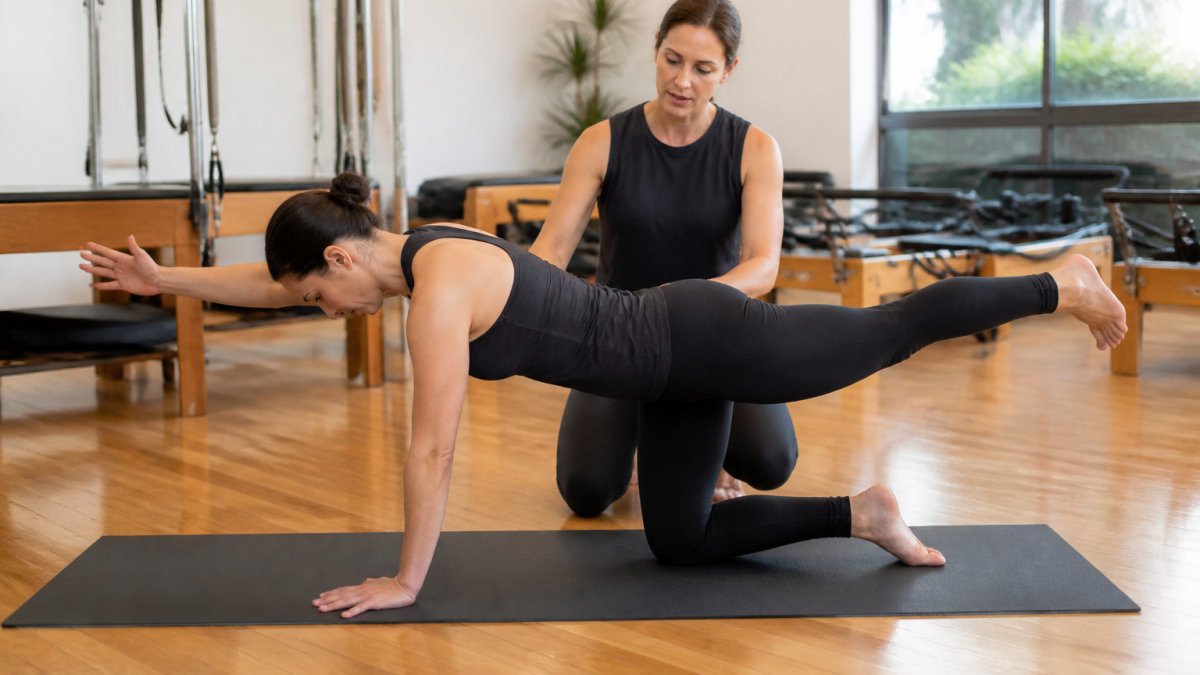
- Bird dog, on hands and knees, extend one arm and the opposite leg without the hips rotating
- Glute bridge, lift the hips while keeping the pelvis level and the ribs down
- Standing hinge, practise hip hinging with a dowel along your spine for feedback
Stage 2: Add load and rotation (weeks 5-10)
Once Stage 1 is clean, add resistance and rotation, where most generic programs stop short:
- Suitcase carry, walk 20 metres holding a weight in one hand only, staying upright and breathing normally
- Pallof press, press a band or cable away from your chest while resisting the pull that wants to rotate you
- Half-kneeling chop and lift, rotate from the ribcage while the pelvis stays square
- Single-leg Romanian deadlift, hinge on one leg with a dowel for feedback, then without
Stage 3: Transfer to your actual life
This is the stage most guides skip.
BOOK YOUR FREE 15 MINUTE CONSULTATION →
Desk-based work. The pattern that breaks down first is thoracic extension.
Running and walking. Trunk control shows up as holding a stable pelvis while the legs move underneath you.
Golf, tennis and other rotational sports. Rotational control is the limiting factor most generic core programs ignore.
Swimming. A stable trunk lets the limbs work without the hips snaking side to side.
How to progress without guessing
Use the assessment as your gate. Move from Stage 1 to Stage 2 only when you pass Tests 1-3, and to Stage 3 only when you pass Tests 4 and 5. If a test regresses, drop back a stage for two weeks rather than pushing through, that is how control becomes automatic.
The most common mistake is progressing too quickly because the first two weeks feel easy. Deep core changes take time to become automatic, and adding load before control is established is how people re-injure a back that was finally settling down.
How Long to Strengthen Your Core (and What Progress Looks Like)
Progress is not linear and rarely shows up as a dramatic moment. It shows up as small things: standing up from a chair without pushing off, sitting through a longer meeting without shifting, bending to tie a shoelace without hesitation.
One of our clients, Zang Angi, described it this way after three months of practice: “I feel noticeably stronger, my core stability has improved, and my lower back pain has significantly reduced.”
Common Mistakes and Safety Guidance
The mistakes that slow people down are predictable, and most come from treating core work as a strength contest rather than a control practice.
Holding your breath. Bracing hard and breathing shallowly raises pressure through the trunk and defeats the exercise’s purpose.
Chasing soreness. Deep core work should not leave you unable to move the next day.
Ignoring the rest of the day. An hour of good movement does not undo eight hours of collapsed sitting.
Mind-Body Connection, Stress, and Movement Quality
Stress changes how you move before you notice it. Under pressure, breathing becomes shallower, the shoulders lift, and the deep core loses its timing.
Movement quality is the practical measure.
ovement assessme
The Menezes Method® builds this into every session through individual mnt and personalised exercise selection.
Chronic back pain and poor posture rarely resolve by adding more exercise to a pattern already working against you.
Frequently Asked Questions
How long will it take to strengthen your core?
Most people notice early changes in how they move within a few weeks of consistent practice, but meaningful core control typically takes around 8 to 12 weeks of regular, progressive work. The timeline depends on your starting point, any existing pain or injury, and how often you practise. Quality of movement matters more than volume, so short, focused sessions several times a week usually beat occasional long ones. A qualified instructor can help you set realistic milestones.
What does core control mean in Pilates and functional movement?
Core control describes your ability to stabilise the spine and pelvis while you move your arms, legs, or whole body. It is less about how many sit-ups you can do and more about coordinating deep core muscles, breathing, and posture so movement stays efficient. In Pilates and functional movement training, core control underpins safe lifting, walking, bending, and sport. The Menezes Method approaches it through concepts like the B-Line, Stable Spine, and SpinalCore to build control you can use in daily life.
Can Pilates help improve core control and spinal stability?
Yes. Menezes Pilates is well suited to building core control because it emphasises controlled movement, breathing, and alignment rather than speed or load. A structured, individualised program can improve deep core muscle activation, pelvic stability, and posture, which supports spinal stability over time. If you have chronic back pain or a diagnosed condition, work with a qualified instructor and check with your treating health professional before starting, so exercises can be adapted to your situation.
How can I practise core control safely during everyday movement?
Start by noticing how you sit, stand, and bend. Keep your ribs and pelvis stacked, breathe steadily, and avoid holding your breath when you lift or reach. When picking something up, hinge at the hips rather than rounding your lower back, and keep the load close to your body. Build core stability exercises gradually, and stop any movement that causes sharp pain. If pain persists, see a qualified health professional for an assessment.
What causes poor core strength or control?
Poor core control often develops from prolonged sitting, previous injuries, pregnancy, or simply never having learned how to activate the deep core muscles effectively. Pain itself can change the way you move, which then reinforces unhelpful patterns. Stress and fatigue also affect coordination and breathing. The good news is that control can be retrained at most ages with targeted, progressive exercise and attention to movement quality.
What are the common myths about core wellness?
Two myths come up often: that core strength is only about visible abdominal muscles, and that more sit-ups equal better core control. In practice, the deep core muscles that stabilise the spine are not the ones you see, and endless crunches can aggravate back pain rather than help it. Another myth is that you need to hold your stomach in tightly all day. Controlled breathing and coordinated activation matter far more than tension.