Last Updated: November 26, 2026
Quick Summary
Pilates modifications for shoulder impingement usually reduce painful arm positions, support the shoulder blade and build movement back in gradually. Keep arm movements below the range that brings on pain, use lighter resistance, and support the arm on a cushion or wall.
- Keep arm movements below the range that brings on pain.
- Use a lighter resistance band or no band.
- Support the arm on a cushion or bench.
- Choose slow, small movements before larger ones.
- Tell the instructor which positions cause pain.
Table of Contents
- Which Pilates Modifications Suit Shoulder Impingement?
- What Shoulder Impingement Is and How It Affects Movement
- Scapular Control and Upper-Back Mobility Before You Start
- Modified Plank for Shoulder Pain
- Modifying Overhead and Reformer Exercises by Apparatus
- Pain-Monitoring Rules, Stop Criteria and Progressions
- Booking a Movement Assessment Before Your First Class
- Frequently Asked Questions
Which Pilates Modifications Suit Shoulder Impingement?
Pilates modifications for shoulder impingement usually reduce painful arm positions, support the shoulder blade and build movement back in gradually. Read why Menezes Pilates works for shoulder impingement to see why this method suits the condition.
Shoulder impingement Pilates modifications can include lowering the arms, reducing load, using a wall or forearms for support, and changing the range of motion.
The term “shoulder impingement” is often used for pain linked to shoulder movement, but it does not identify one cause on its own. For general guidance on shoulder pain and activity, see Healthdirect’s shoulder pain information through Healthdirect shoulder pain information.
Start with these practical changes:
- Keep arm movements below the range that brings on pain.
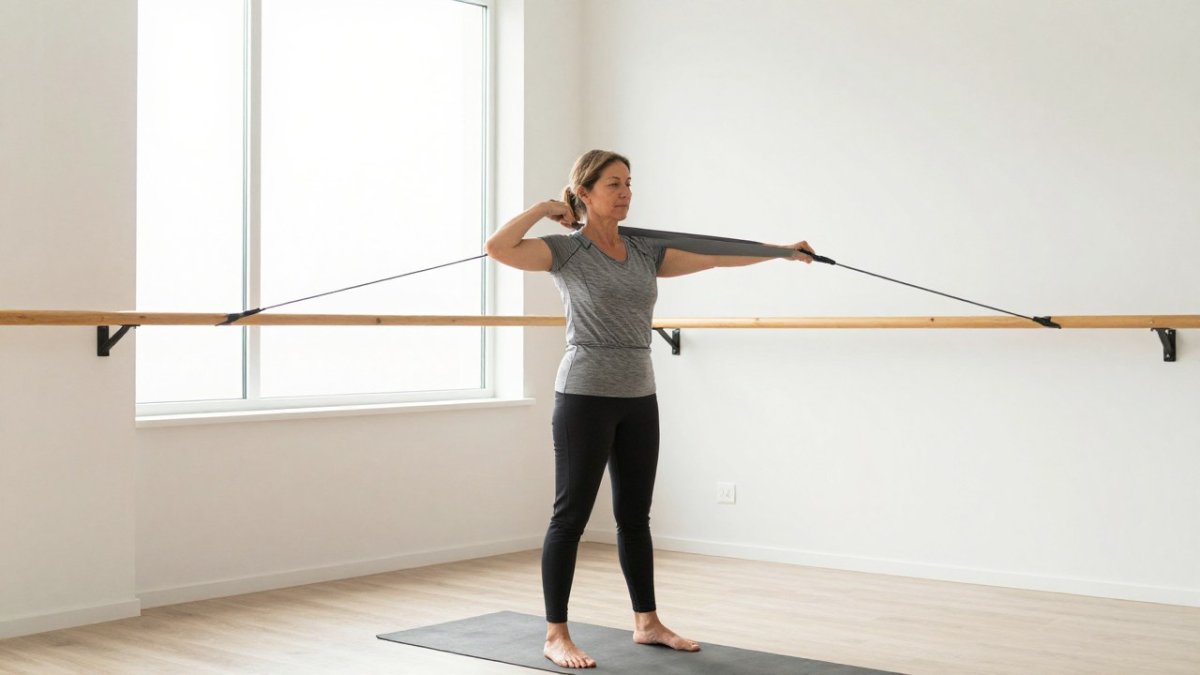
- Use a lighter resistance band or no band.
- Support the arm on a cushion or bench.
- Choose slow, small movements before larger ones.
- Tell the instructor which positions cause pain.
A common mistake is treating every shoulder symptom as the same problem. Pilates can support movement and strength, but it cannot confirm a diagnosis or replace an assessment.
What Shoulder Impingement Is and How It Affects Movement
Shoulder impingement is a common term for shoulder pain that can occur during arm movement, especially when reaching or lifting overhead.
The rotator cuff is a group of muscles and tendons that help move and steady the shoulder.
During Pilates, notice how the shoulder blade and rib cage move together. Avoid pinning the shoulder blades down or pulling them back hard.
Common movements that may need adjustment include:
- Reaching overhead or lifting the arm out to the side.
- Holding body weight through the hands.
- Pulling a resistance band with the elbows high.
- Repeating a movement that increases pain.
The Australian Physiotherapy Association’s shoulder information can help readers understand shoulder care and when to seek professional advice, via Australian Physiotherapy Association shoulder health information.
Scapular Control and Upper-Back Mobility Before You Start
Scapular control means moving the shoulder blade with the arm, rather than holding it rigidly in place. Gentle upper-back movement and easy shoulder-blade exercises can prepare you for Pilates, provided they do not worsen your symptoms. Start with small, comfortable actions and keep breathing.
Try this brief warm-up:
- Sit tall with your feet supported.
- Let your arms rest by your sides.
- Breathe in without lifting your shoulders.
- Slowly draw the shoulder blades slightly forward, then release.
- Repeat with a small, easy range.
- Stop if pain rises or movement feels unsafe.
For a video-style cue, picture the shoulder blade gliding around the ribs as the arm reaches forward. It should not be forced down or squeezed together.
A common mistake is trying to “fix posture” by holding the chest high all day. For a broader movement screen before exercise, read our personalised movement assessment guide. Our article on mobility in orthopaedic rehabilitation explains how gentle movement may fit into a broader plan.
Modified Plank for Shoulder Pain
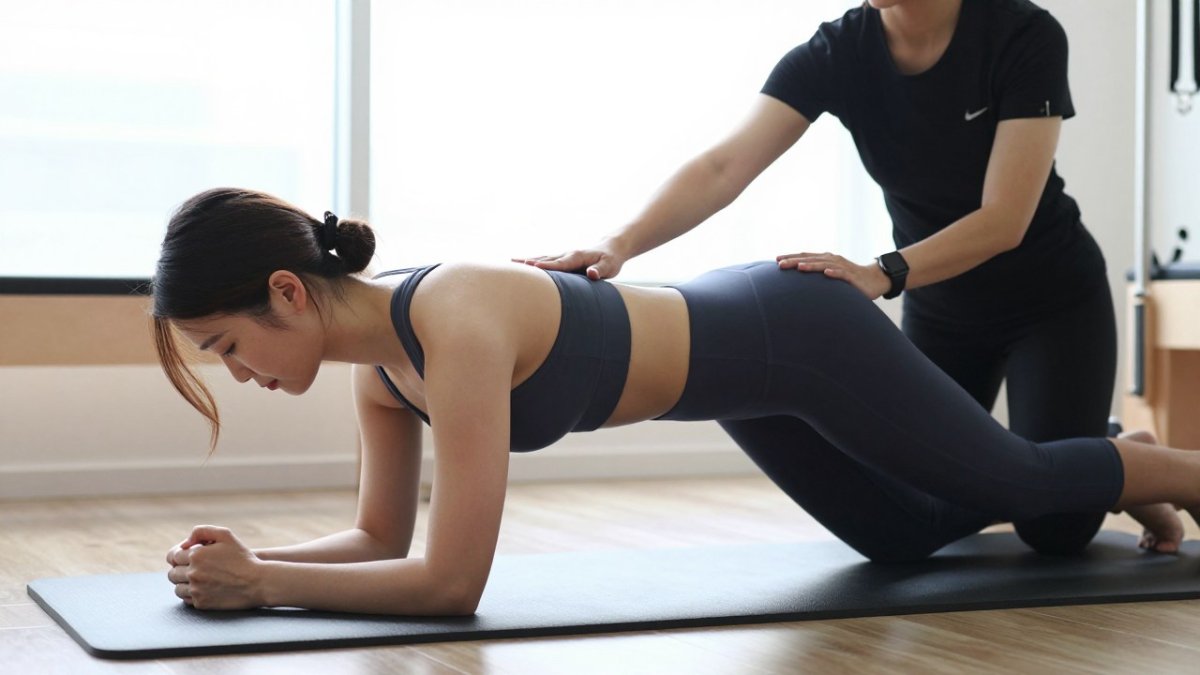
A modified plank for shoulder pain reduces the load through the arms while keeping the trunk supported.
(/clinical-pilates-for-shoulder-bursitis-safe-guide/).
Modifying Overhead and Reformer Exercises by Apparatus
Overhead work and reformer exercises can often be changed by reducing range, load or time under tension. The right adjustment depends on the movement and your response.
The table below sets out common Pilates movements and the specific setup changes that usually make them manageable.
| Exercise or setup | Possible adjustment | What to watch |
|---|---|---|
| Front raise (mat or standing) | Lift only to a comfortable height, or trace the arm forward along a wall | Shoulder hiking toward the ear |
| Band pull-apart | Keep elbows low and use a lighter band; shorten the range | Neck tightening or ribs flaring |
| Forward press | Shorten the reach and press slightly downward rather than straight ahead | Pain during the push |
| Reformer arm work | Use lighter spring tension and reduce the number of repetitions | Loss of smooth control |
| Overhead reach in standing | Stop below the painful range; keep the ribs stacked over the pelvis | Arching the lower back to gain height |
| Prone extension (lying face down) | Place a folded towel under the forehead and keep the arms closer to the body | Lifting the head and neck instead of the upper back |
| Quadruped arm lift | Lift one arm only to shoulder height, or slide the hand forward along the floor | Weight shifting excessively to one side |
| Side-lying arm work | Support the head on a cushion and keep the working arm below shoulder height | Rolling the trunk backward to help the arm |
For overhead work, begin below the painful range. Do not force the arm higher by arching the back or flaring the ribs.
The same idea applies to lateral presses, prone extension and quadruped work. If you are adapting overhead or reformer exercises, read our guide to clinical Pilates for rotator cuff injuries.
Mat, Reformer and Band: How the Modifications Differ
The three main formats load the shoulder in different ways, so the adjustment is not always the same.
- Mat work: the body weight and the position of the arms do most of the loading. The easiest change is usually to raise the support (a wall instead of the floor, a bench instead of a mat) or to shorten the lever by bending the elbow.
- Reformer work: the springs and the carriage add resistance and momentum. Change the spring first, then the range, then the number of repetitions. Ask the instructor to spot the shoulder during the first attempt at any new setting.
- Resistance bands: the band tension rises as it stretches, so the end of the range is often the hardest part. Use a lighter band, hold it closer to the anchor, or stop before the end range. A loop band around the wrists during side-lying work is often easier to control than a long band held in the hands.
Watch out: swapping a floor exercise for a wall version is not automatically easier if you then hold it for much longer. Keep the hold time the same or shorter when you change the setup, so you can tell whether the change helped.
Pain-Monitoring Rules, Stop Criteria and Progressions
Use your pain response and movement quality to decide whether to continue, reduce the task or stop. A mild, brief sensation is different from pain that grows, spreads or remains worse after exercise. Because symptoms vary, a qualified clinician should guide decisions when pain is ongoing or unclear.
A Simple Discomfort Scale
Rate the sensation during the movement on a 0 to 10 scale, where 0 is no sensation and 10 is the worst pain you can imagine.
- 0 to 2: comfortable. Continue, keeping the movement slow and controlled.
- 3 to 4: noticeable but tolerable. Continue only if the sensation settles within a minute of stopping and does not climb.
- 5 and above: too much. Reduce the range, load or repetitions, or stop the exercise.
A common pattern practitioners use is the “two-hour rule”: if the shoulder is no worse two hours after class than it was before, the session was probably within tolerance. If it is clearly worse the next morning, the next session should start at a lower level.
Stop Criteria
End the exercise and rest if any of the following occur:
- Pain becomes sharp, stabbing or spreading down the arm.
- The arm feels weak, heavy or numb during or after the movement.
- The shoulder catches or locks rather than moving smoothly.
- Symptoms are still worse the following day.
Seek prompt medical care for sudden severe pain, a new loss of strength, major swelling, or symptoms after a serious injury. These signs need assessment rather than a Pilates adjustment. For general information about shoulder symptoms and care, consult Healthdirect’s shoulder pain guidance via Healthdirect guidance on shoulder pain and care.
Progressing Back to Overhead and Loaded Work
Progress one feature at a time. For example, first make a wall press feel smooth; later, increase the reach or move to a lower support. Do not raise the load, range and speed together.
A staged pathway that many instructors follow looks like this:
- Supported and small: wall or bench support, short range, no resistance, slow tempo. Aim for smooth movement at 0 to 2 on the scale.
- Supported with more range: same support, slightly larger range or a longer hold, still no added resistance.
- Less support: move from wall to bench, or from bench to floor, keeping the range the same.
- Light resistance: add a light band or the lightest sensible spring, keeping the range and tempo unchanged.
- Overhead and loaded work: reintroduce overhead reach and heavier resistance only when the previous stage has been comfortable for several sessions in a row.
Move back a stage if symptoms rise above 4 during the session or are worse the next day. That is information, not failure.
Watch out: the most common progression error is adding range and resistance in the same week. Change one variable, keep the others steady for at least two or three sessions, and note the response before moving on.
Booking a Movement Assessment Before Your First Class
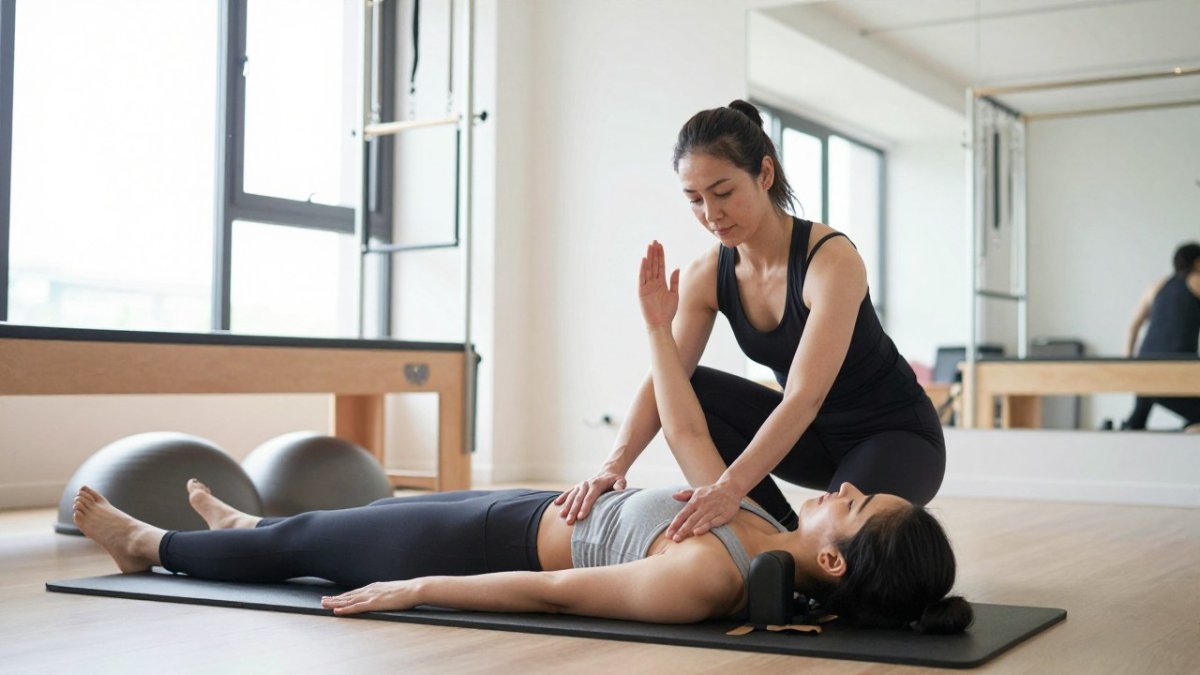
A movement assessment can help match Pilates exercises to your current shoulder movement, symptoms and goals. It does not replace medical diagnosis.
Before your first class, prepare a short note:
- Which movements bring on shoulder pain?
- What activities feel easier or harder?
- Have you received advice from a clinician?
- Which positions or exercises have you already changed?
- What would you like to return to doing?
Bring the note to your instructor and ask how each exercise can be changed. If you have not had persistent or worsening shoulder pain assessed, speak with a qualified health professional first.
Shoulder pain can make exercise choices feel uncertain, especially when symptoms change from day to day. A personalised movement assessment can help you discuss suitable options and progressions.
Frequently Asked Questions
Can I do Pilates with shoulder impingement?
Many people with shoulder impingement can take part in Pilates, provided exercises are chosen and set up to avoid painful positions. Work on scapular control, upper-back mobility and rotator cuff strength, and avoid forcing the arm overhead beyond a comfortable range. Mention your shoulder to your instructor before class so they can offer alternatives. If pain is sharp, radiates or lingers after sessions, stop and seek a professional assessment before continuing.
Which Pilates exercises should I modify with shoulder impingement?
Exercises that load the arm overhead or press the shoulder into end range often need changes, including some overhead arm work and certain plank variations. A modified plank on the forearms and knees, reduced range in arm movements and smaller arcs can keep you active. Your instructor can adjust the setup for your apparatus and class format. Pain-free range is the guide, not the exercise name.
How can I modify planks if I have shoulder impingement?
A modified plank for shoulder pain usually means lowering load through the arms by resting on the forearms or knees rather than the hands. Keep the spine long, breathe steadily and avoid letting the shoulders collapse toward the floor. Shorten the hold and build time gradually. If the shoulder pinches or aches during the hold, reduce the position further or stop.
When should I stop a Pilates exercise because of shoulder pain?
Stop an exercise if you feel sharp pain, pinching at the front or top of the shoulder, numbness, tingling or pain that worsens during or after the movement. Pain that lingers into the next day is also a signal to scale back. Pain is a useful guide, but it does not replace a professional assessment. Anyone with significant or unexplained symptoms should seek appropriate medical advice first.