Last Updated: November 2, 2026
Quick Summary
Mobility exercises improve orthopedic rehabilitation by restoring active joint range of motion under your own control, which supports walking, sitting, reaching and lifting without compensation. They differ from passive stretching because you drive the movement yourself, starting small and slow and building range gradually.
- Flexibility is passive range, while mobility is active control through that range.
- Match joint mobility exercises after surgery to the procedure and recovery stage.
- Move forward when a movement is easy and pain-free, not when days have passed.
- Early post-surgical sessions of 5-10 minutes work best 2-3 times daily.
- Track range of motion, walking tolerance, balance and functional tasks weekly.
Table of Contents
- Why Improved Mobility Matters in Orthopedic Rehabilitation
- Mobility Exercises for Rehabilitation: A Practical Starting Point
- Joint Mobility Exercises After Surgery: Matching the Exercise to the Procedure
- Safe Progression of Rehabilitation Exercises: Signs You Are Ready to Move Forward
- How Often to Do Mobility Exercises in Rehabilitation
- Safety Precautions, Stop Signals and Measurable Milestones
- Building Your Home Mobility Program Around Core Control
- Booking Your Free 15 Minute Consultation
- Frequently Asked Questions
Why Improved Mobility Matters in Orthopedic Rehabilitation
Improved mobility for orthopedic rehabilitation is the difference between a joint that has healed and a body that moves well again. At Menezes Method Pilates, we have spent decades watching people regain movement after injury and surgery, and the pattern is consistent: the people who recover best are the ones who restore motion deliberately, not the ones who simply wait for pain to fade.
Mobility is not a luxury add-on to recovery. It is the foundation for walking, sitting, reaching and lifting without compensation.
Mobility Is Not the Same as Flexibility
Flexibility is passive range. It is how far a joint moves when something or someone else does the work.
Mobility is active control through that range. It means your muscles can take your joint there and hold it steady.
You can be very flexible and still have poor mobility. Loose joints without control are a recipe for instability after surgery.
How Mobility Connects to Joint Health and Daily Function
Joints rely on movement to stay healthy. Cartilage and surrounding tissues respond to regular loading and motion.
When a joint stays stiff, nearby joints pick up the slack. A stiff hip changes how you walk. A stiff knee changes how you climb stairs.
For a deeper look at how Pilates supports recurring back pain, see our guide to Chronic Back Pain: A Guide to Pilates & Core Stability.
That compensation is where many secondary problems begin.
Mobility Exercises for Rehabilitation: A Practical Starting Point
Mobility exercises for rehabilitation are controlled, active movements that restore joint range of motion while you stay in charge of the movement. They differ from passive stretching because you drive the motion yourself.
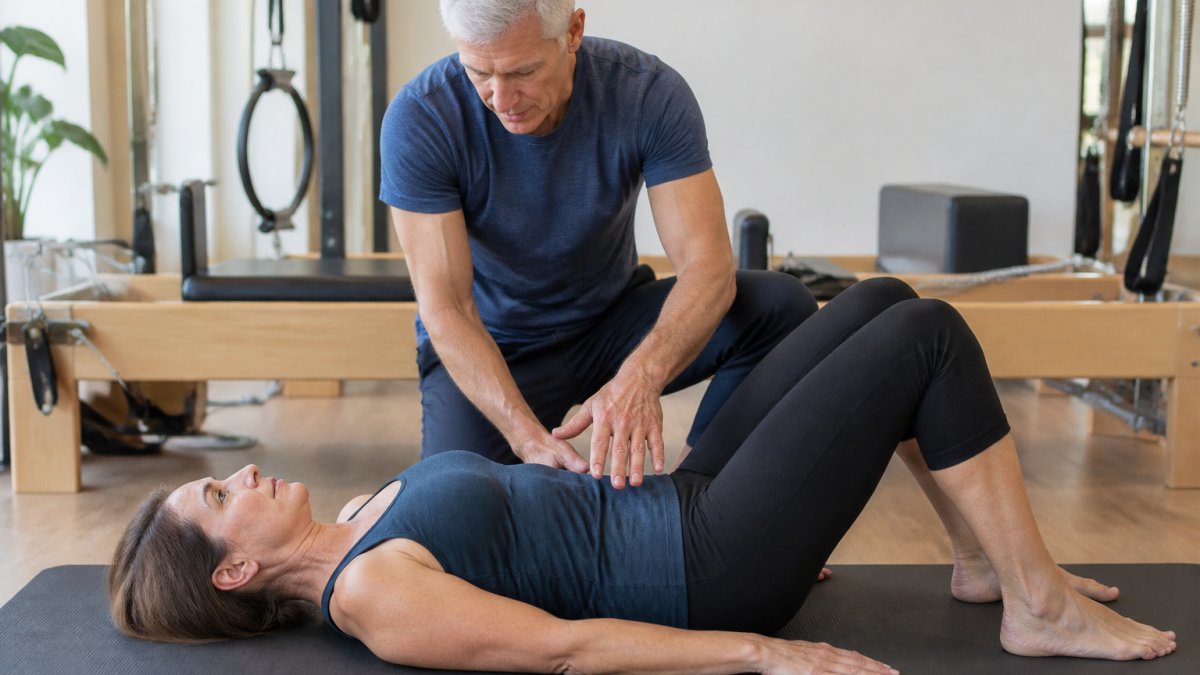
Start with small, slow movements and build range gradually. A common mistake is pushing into the end of range too early and irritating healing tissue.
Hip, Knee and Shoulder Mobility Basics
- Hip: slow hip circles, seated hip rotations, gentle hip extension in standing
- Knee: seated knee extensions, heel slides, controlled sit-to-stand
- Shoulder: pendular swings, wall slides, overhead reach within comfort
Keep each movement smooth. Quality beats quantity every time.
Joint Mobility Exercises After Surgery: Matching the Exercise to the Procedure
Joint mobility exercises after surgery must match the procedure and the stage of recovery. A hip replacement, a knee replacement and a shoulder repair all follow different rules. Your surgeon and rehabilitation team set the boundaries.
A useful way to think about it is in three stages. In the protected stage, the goal is safe range and reducing swelling, not stretching. In the rebuilding stage, the goal is active control through the range you have. In the return stage, the goal is loading the joint in real tasks such as stairs, carrying and sport-specific movement.
Hip and Knee Replacement Recovery
After hip or knee arthroplasty, early mobility work focuses on safe range and gait. Sit-to-stand practice, heel slides and supported walking all help.
Hip precautions vary by surgical approach. Some surgeons restrict bending past 90 degrees, crossing the legs or turning the operated leg inward for a period after posterior-approach surgery.
Pelvic control matters in both cases. If the pelvis shifts or drops, the new joint takes uneven load.
Shoulder and Upper Limb Recovery
Shoulder recovery is often slower and more cautious. Graded movement and scapular control guide the program. Pendular swings, table slides and assisted elevation within the range your surgeon allows are typical early movements.
Our article on why Menezes Method Pilates works for shoulder impingement explains how graded movement and scapular control are applied.
Forcing overhead range before your surgeon clears it can set recovery back by weeks, particularly after rotator cuff repair where the repair must be protected while it heals.
Matching the Exercise to the Stage
| Recovery stage | Typical focus | Example movements | What to avoid |
|---|---|---|---|
| Protected (early weeks) | Safe range, swelling control, gentle activation | Heel slides, pendular swings, supported sit-to-stand, ankle pumps | End-range stretching, loading through pain, skipping walking aids |
| Rebuilding (mid stage) | Active control through available range | Seated knee extensions, wall slides, standing hip extension, weight shifts | Pushing range faster than control allows |
| Return (later stage) | Load, endurance and real tasks | Step-ups, carrying, overhead reach, sport-specific drills | Sudden increases in volume or impact |
These stages overlap, and timelines differ by procedure, age and general health. Use them to organise your program, not to self-prescribe a timeline.
Stop Signals After Surgery
Stop and contact your surgical or rehabilitation team if you notice:
- Sharp or worsening pain that does not settle with rest
- New numbness, tingling or weakness
- Significant swelling, heat or redness around the joint
- A joint that gives way or feels unstable
- Dizziness or unusual shortness of breath
These are general guardrails, not a diagnosis. Your treating team knows your procedure and your history, so their advice overrides any general list.
Safe Progression of Rehabilitation Exercises: Signs You Are Ready to Move Forward
Safe progression of rehabilitation exercises depends on control, not on the calendar. You move forward when the current movement is easy and pain-free, not when a set number of days has passed.
BOOK YOUR FREE 15 MINUTE CONSULTATION →
Signs you are ready to progress:
- The movement feels smooth and controlled
- You can breathe normally throughout
- No swelling or pain flare the next day
- You can repeat it without losing form
If any of these slip, hold at the current level. The Australian Commission on Safety and Quality in Health Care publishes resources on safe, person-centred care that support this cautious approach.
How Often to Do Mobility Exercises in Rehabilitation
How often to do mobility exercises in rehabilitation depends on the joint and the stage. Little and often usually beats long and occasional.
A practical rhythm:
| Stage | Frequency | Session Length |
|---|---|---|
| Early post-surgical | 2-3 times daily | 5-10 minutes |
| Mid rehabilitation | Daily | 10-15 minutes |
| Late stage | 4-5 times weekly | 15-20 minutes |
| Maintenance | 3 times weekly | 15-20 minutes |
Short, frequent sessions keep the joint moving without overloading healing tissue. Guidance from the Australian Institute of Health and Welfare shows how common musculoskeletal conditions are, which is why consistent habits matter.
Repetitions, Rest and Progression
A simple structure works well for most people:
- Repetitions: 5-10 slow repetitions per movement, stopping before fatigue changes your form
- Rest: a few minutes between movements, and a full rest day if a joint is swollen or sore the next morning
- Progression: add range or repetitions only when the current dose feels easy and controlled
Progression should follow control, not the calendar. If a movement is smooth, pain-free and you can breathe normally throughout, you can add a small amount of range or one extra repetition. If not, hold at the current level.
Measuring Progress With Functional Milestones
Frequency only matters if you can see progress. Track a few practical measures rather than relying on how you feel on any given day:
- Range of motion: how far you can bend or lift the joint, measured against your other side or a baseline
- Walking tolerance: how long you can walk before symptoms change
- Balance: how long you can stand on one leg with control
- Functional tasks: sit-to-stand repetitions in 30 seconds, stair climbing, reaching overhead
Record these weekly. A steady trend matters more than any single session.
Coordinating Home Exercises With Your Rehabilitation Team
Your home program should sit inside your physiotherapy or rehabilitation plan, not replace it. A common pattern is to do your prescribed exercises at home and use your clinic sessions to check technique, progress load and adjust the plan. Bring your tracking notes to appointments so your clinician can see what is working.
If you are unsure whether to progress, hold at the current level for another week and ask your clinician at your next appointment. Holding is rarely the wrong choice; advancing too quickly often is.
Safety Precautions, Stop Signals and Measurable Milestones
Safety precautions and stop signals matter more than any exercise list. Knowing when to stop protects your recovery.
Stop and seek advice if you notice:
- Sharp or worsening pain
- New numbness, tingling or weakness
- Significant swelling or heat around the joint
- Dizziness or unusual shortness of breath
Measurable milestones keep you honest. Track things like step length, sit-to-stand repetitions, and how far you can reach overhead. These show real functional movement progress.
Building Your Home Mobility Program Around Core Control
A home mobility program works best when it sits on top of core control. Mobility without stability is just range you cannot use.
The Menezes Method uses individual movement assessment and personalised exercise selection. We teach breathing, posture and spinal position together, so mobility work transfers into daily life.
If you want a structured plan to follow at home, our article on how to improve spinal control at home gives you a 7-step plan to build on.
Booking Your Free 15 Minute Consultation
Recovering mobility after surgery or injury takes patience and the right guidance. Generic routines rarely fit a healing joint, and guessing can cost you progress.
At Menezes Method Pilates, we build programs around your assessment, using the B-Line®, Stable Spine and SpinalCore® to improve control and movement. You can review our session and pricing details before you book.
Get started with Menezes Method Pilates and move with more confidence. Book your free 15 minute consultation today.
Frequently Asked Questions
What does mobility mean in orthopaedic rehabilitation?
Mobility is the ability to move a joint through its available range with control, rather than just how far it stretches. In rehabilitation it covers range of motion, joint health, coordination and movement quality for daily tasks like walking, sit-to-stand and reaching overhead. It differs from flexibility, which is passive length. Mobility exercises are typically active and are progressed gradually as healing allows, and a qualified professional can assess where your control breaks down.
How often should I practise mobility exercises during rehabilitation?
Frequency depends on your surgery, stage and how your joint responds. Many rehabilitation programs use short, frequent sessions rather than one long one, because gentle movement repeated through the day can help reduce joint stiffness. A common approach is a daily routine of brief mobility exercises, with strength and balance work on alternate days, but your treating professional sets the schedule. Track how you feel the next day and adjust with guidance rather than pushing through pain.
How do I know whether a mobility exercise is safe for me?
Safety comes down to the right exercise at the right stage. Stop and seek advice if you notice sharp pain, swelling that worsens, numbness, tingling, limb weakness, or a sudden loss of movement. Avoid self-prescribing after surgery without clearance from your surgeon or physiotherapist. A supervised assessment can identify which movements suit your procedure and recovery stage, and which should wait. Mild stiffness that eases with gentle movement is different from pain that persists or escalates.
Can Pilates support mobility during orthopaedic rehabilitation?
Pilates-based movement can support rehabilitation when it is individualised and supervised. The Menezes Method, for example, emphasises core control, spinal position and breathing rather than completing repetitions quickly, using concepts such as the B-Line and Stable Spine. This suits people returning to exercise after injury or surgery who need quality of movement. Always confirm with your treating professional that Pilates is appropriate for your stage, and choose a program that assesses you individually rather than a generic group class.
Mobility work is not about pushing harder. It is about moving better, one controlled repetition at a time. If you are unsure where to begin, a short consultation can point you in the right direction.