Last Updated: October 25, 2026
Quick Summary
The top 5 benefits of clinical Pilates for posture are better spinal alignment and joint mobility, stronger postural and back muscles, less neck and back pain and muscle tension, improved flexibility and muscle balance, and body awareness that carries into daily activities. Clinical Pilates posture work targets core control, not core strength. Progress is usually gradual over weeks rather than days.
- Postural change comes from five connected elements: breathing, spinal position, pelvic stability, muscle activation and movement quality.
- Back problems affect around one in six Australians, according to the Australian Institute of Health and Welfare.
- Postural muscles need endurance more than raw force because they hold you upright all day.
- Practise most days for short periods and attend a guided session weekly or as advised.
- Seek professional assessment first if you have radiating pain, numbness, tingling or limb weakness.
Table of Contents
- Why Clinical Pilates Posture Work Starts With Core Control
- Benefit 1: Spinal Alignment and Joint Mobility
- Benefit 2: Strengthening Postural Muscles and Back Muscles
- Benefit 3: Less Neck Pain, Back Pain and Muscle Tension
- Benefit 4: Flexibility, Range of Motion and Muscle Balance
- Benefit 5: Body Awareness That Carries Into Daily Activities
- Clinical Pilates vs Regular Pilates: What Actually Changes
- Pilates Exercises for Spinal Alignment and How Often to Practise
- Start With Control, Not Strength
- Frequently Asked Questions
Why Clinical Pilates Posture Work Starts With Core Control
Most people assume better posture comes from sitting up straighter or strengthening their abs. At Menezes Method Pilates, we take a different view. The top 5 benefits of clinical pilates for posture all trace back to one principle: core control, not core strength. You can have strong abdominal muscles and still have poor spinal control, poor breathing patterns and recurring back pain. Clinical Pilates posture work targets the timing and quality of muscle activation, not how hard you can brace. That distinction shapes everything below.
The Five Elements That Drive Postural Change
Postural change comes from five connected elements, not from one exercise:
- Breathing: the diaphragm, abdominal wall and pelvic floor work together to manage pressure through the trunk
- Spinal position: the spine needs stability without rigidity, which is why we teach Stable Spine® rather than forcing the back flat
- Pelvic stability: the pelvis links trunk and legs, so unnecessary tilting or shifting forces other areas to compensate
- Muscle activation: the core is a coordination system, not a single muscle
- Movement quality: control must transfer into standing, walking, bending and lifting
Miss any one of these and posture work stalls.
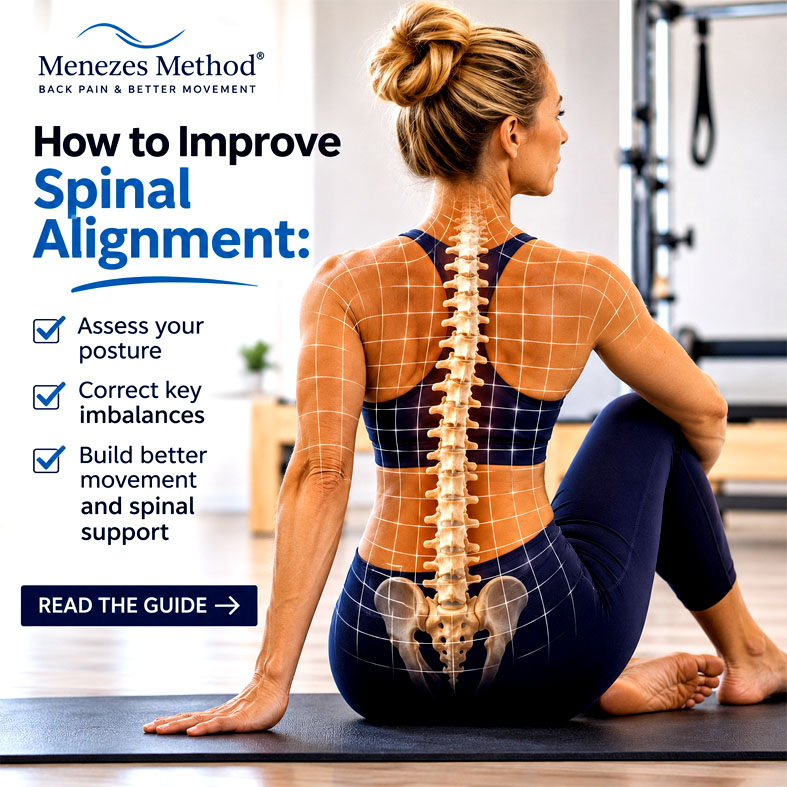
Benefit 1: Spinal Alignment and Joint Mobility
The first benefit is better spinal alignment and joint mobility. Clinical Pilates posture work teaches you to create length through the spine while keeping normal movement available. That matters because a stiff, over-braced spine is not a stable one.
The Australian Institute of Health and Welfare reports that back problems affect around one in six Australians. Many of those people sit for long hours, which gradually reduces spinal mobility and joint range.
What Actually Changes in the Spine
Alignment is not a single fixed position. It is the ability to move into and out of positions under control. Clinical Pilates posture work targets three things at once:
- Segmental control: moving one part of the spine while the rest stays organised, rather than moving as a block
- Available range: restoring extension, rotation and side-bending that sitting and guarding have reduced
- Endurance in range: holding an aligned position long enough to be useful, not just long enough to be photographed
Precise cues help here. Our B-Line® concept gives a specific reference point for lower abdominal activation, below the navel, instead of the vague “pull your navel to your spine” instruction. You learn where control actually starts, then carry that reference into spinal movement.
How You Would Know It Is Working
Realistic indicators include:
- Sitting or standing comfortably for longer before you feel the need to shift
- Being able to rotate or side-bend further without the lower back collapsing
- Less stiffness on waking and less fatigue through the mid-back by late afternoon
- Being able to hold a hip hinge or single-leg stance without the pelvis drifting
These are functional markers, not a promise of a specific posture correction. Outcomes vary by person and condition, and progress is usually gradual over weeks rather than days.
Track two or three of these markers weekly in a simple note. Control that improves in the studio but not in daily life is a signal to change the exercise selection, not to train harder.
Benefit 2: Strengthening Postural Muscles and Back Muscles
Postural muscles need endurance more than raw force. They hold you upright all day, so the goal is steady, low-level support that lasts.
Clinical Pilates posture training builds that endurance in the back muscles, deep core and surrounding postural muscles. Exercises progress gradually, so fatigue does not force you into poor compensation.
A common mistake is chasing harder exercises too early. In practice, a client who masters controlled activation on simple movements holds better posture at their desk than one who rushes to advanced work. Quality of movement beats difficulty every time.
Benefit 3: Less Neck Pain, Back Pain and Muscle Tension
Reducing neck pain, back pain and muscle tension is the benefit most clients notice first. When the deep core, diaphragm and spinal stabilisers share the load, the neck and lower back stop overworking.
That does not mean pain disappears overnight. Realistic expectations matter. For readers managing ongoing pain, graded exercise can fit into a longer recovery plan. For a deeper guide to Pilates and core stability, see Chronic Back Pain: A Guide to Pilates & Core Stability.
Watch out: pushing through sharp or radiating pain is the fastest way to set yourself back. Control first, load second.
Benefit 4: Flexibility, Range of Motion and Muscle Balance
Flexibility and range of motion improve when muscles stop guarding. Tight hip flexors and overactive back muscles often create the appearance of poor posture, when the real issue is muscle imbalance.
Clinical Pilates posture work pairs stretching with controlled movement, so you gain range you can actually use. Muscle balance improves because both sides of the body train through coordinated patterns, not isolated crunches.
BOOK YOUR FREE 15 MINUTE CONSULTATION →
The result is movement that feels easier, not just looser.
Benefit 5: Body Awareness That Carries Into Daily Activities
The final benefit is body awareness that carries into daily activities. This is where posture change becomes permanent, and it is the area most benefit-focused pages leave vague.
You learn to notice how you sit, stand, bend and lift. Then you adjust before strain builds. Breathing stays normal, the spine stays organised and the pelvis stays steady.
What a Posture-Focused Session Actually Looks Like
Awareness is built through repetition with feedback, not through a lecture. A typical progression follows a clear logic:
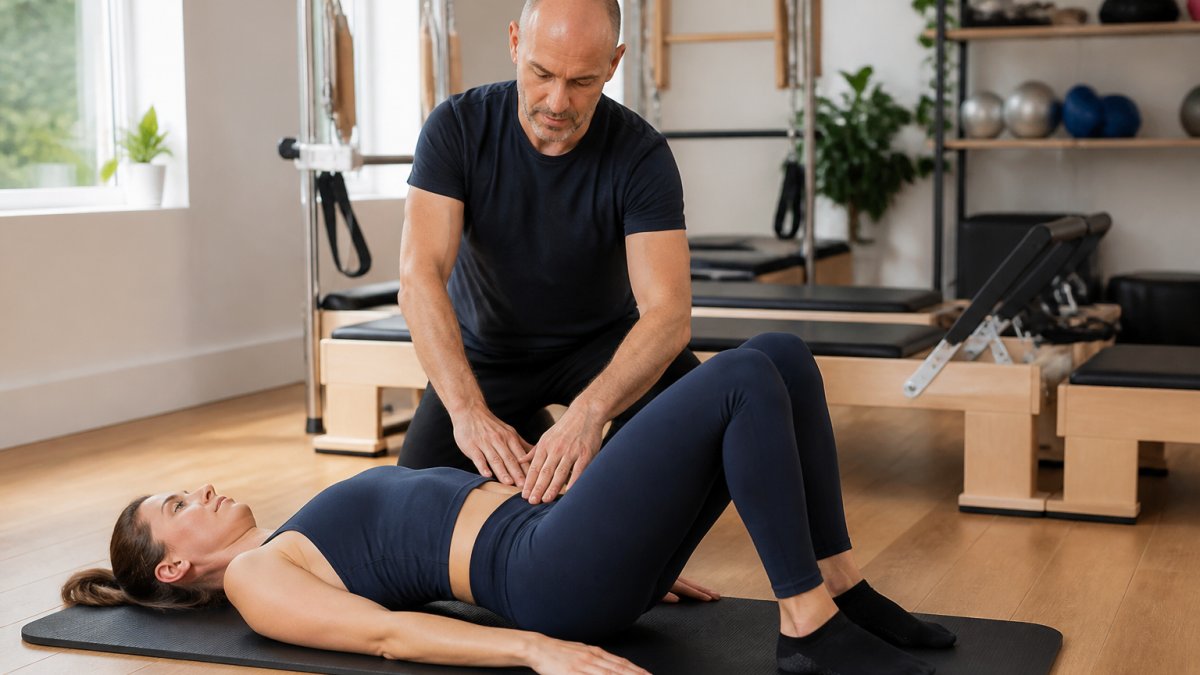
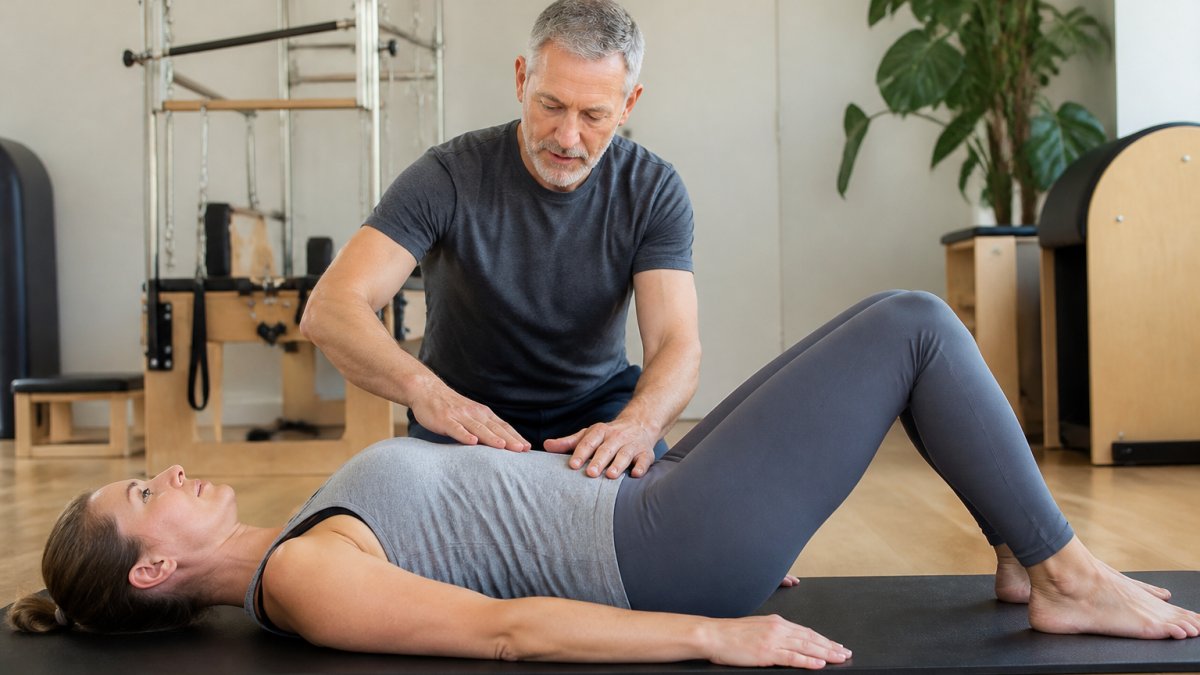
- Assessment first. A movement screen identifies where control breaks down, using tests such as breathing with rib expansion, leg lowering with a stable pelvis, a standing hip hinge, single-leg stance and a loaded carry.
- Exercise selection. The session targets the weakest link, not the whole body at once. If the pelvis drifts during leg lowering, that pattern is trained before load is added.
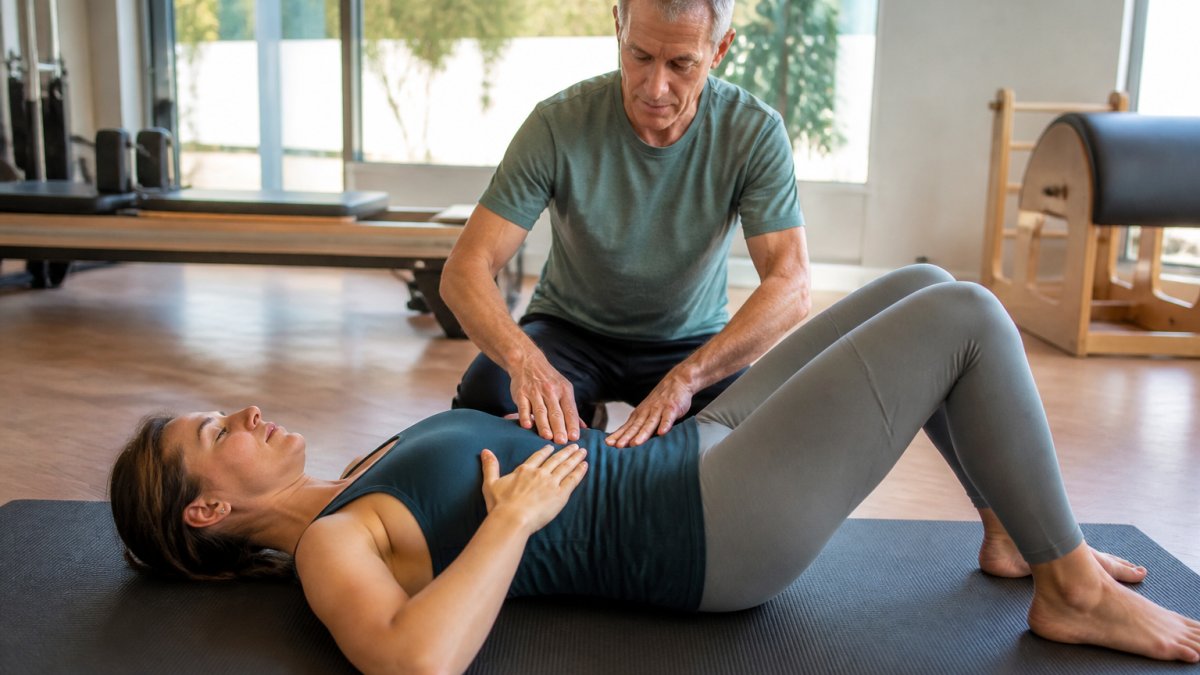
- Feedback. A cue such as the B-Line® reference for lower abdominal activation gives you something specific to feel, rather than a general instruction to brace.
- Progression. Load, range or complexity increases only when control holds with normal breathing. If breathing is lost, the exercise is too hard for that day.
- Transfer. The final step is applying the same control to a real task, such as lifting a shopping bag or carrying a child, so the skill leaves the studio.
When to Seek Assessment or Modify Exercise
Awareness work is not appropriate for everyone without guidance. Seek professional assessment before starting, or modify your approach, if you have:
- Significant radiating pain, numbness, tingling or limb weakness
- Unexplained night pain, fever or recent trauma
- Pregnancy, recent surgery or an existing diagnosed condition affecting the spine or pelvis
- Pain that worsens during or after exercise rather than settling
Most practitioners find that graded, assessment-led exercise is safer and more effective than pushing through symptoms, and that modifying an exercise is a normal part of progression rather than a failure.
If a movement produces sharp or radiating pain, stop. Control first, load second. A qualified clinical instructor can adjust the exercise rather than asking you to push through.
For readers who want to keep progressing between sessions, our seven-step plan to improve spinal control at home gives you a practical structure to follow.
Clinical Pilates vs Regular Pilates: What Actually Changes
The difference between clinical Pilates and regular Pilates often comes down to assessment and individualisation. A general class may follow a set routine. Clinical Pilates often starts with a movement assessment, then selects and modifies exercises for your body.
| Feature | Regular Pilates | Clinical Pilates |
|---|---|---|
| Starting point | Group routine | Individual assessment |
| Exercise selection | Same for everyone | Tailored to your movement |
| Progression | Fixed class plan | Adjusted as control improves |
| Best for | General fitness | Posture, pain and rehabilitation |
If you are weighing up whether to start, Zang Angi reported feeling noticeably stronger with reduced lower back pain after three months. You can also read real client experiences before committing. You can also review pricing and session details before booking.
Pilates Exercises for Spinal Alignment and How Often to Practise
Pilates exercises for spinal alignment focus on controlled movement, not repetition counts. A short, precise session beats a long, sloppy one.
A posture-focused progression usually looks like this:
- Breathing with rib expansion, lying down
- Leg lowering while the pelvis stays controlled
- Hip hinge practice standing
- Single-leg stance with a level pelvis
- Loaded carry with normal breathing
If you worry about doing the wrong movement, it’s important to understand how to exercise safely before you start.
How Often to Do Pilates for Posture
Practise most days for short periods, and attend a guided session weekly or as advised. Consistency matters more than duration. Many people find ten focused minutes daily beats one long weekly session. Progress is measured by control, not by how sore you feel afterwards.
Start With Control, Not Strength
Posture change is a skill, not a workout. The challenge is unlearning old habits while building new ones, and that is hard to do alone. At Menezes Method Pilates, we use individual movement assessment, the B-Line® cue for precise lower abdominal activation and the Stable Spine® approach to build control that lasts. Our method has been taught since 1986 by Australia’s most experienced Pilates Master Trainer. Get started with Menezes Method Pilates and book your free 15 minute consultation to find out where your control breaks down.
Frequently Asked Questions
Is Pilates good for posture?
Pilates can support better posture when it trains control rather than just strength. Clinical Pilates posture work focuses on the deep core muscles, spinal alignment and breathing so the spine stays organised during sitting, standing and lifting. General classes help too, but an individual assessment matters more if you have existing back or neck pain. Progress is usually gradual, so expect weeks of consistent practice rather than overnight change.
What is the difference between clinical Pilates and regular Pilates?
Regular Pilates usually follows a group routine where everyone completes similar exercises. Clinical Pilates often starts with a movement assessment, then selects and modifies exercises for your specific presentation, whether that is chronic lower back pain, pelvic instability or postural strain from desk work. The distinction between clinical and regular Pilates often comes down to individualisation, exercise progression and how closely the instructor watches movement quality rather than rep counts.
How often should I do Pilates for posture results?
Most people do well with two to three short sessions per week, plus brief daily awareness practice such as checking your sitting position or doing a few breathing reps at your desk. Consistency matters more than duration. If you are returning after injury or have significant pain, start with professional guidance and build frequency gradually rather than pushing through fatigue.
How long does it take to notice posture changes with clinical Pilates?
Many people notice improved body awareness within a few weeks, while visible postural change and better endurance typically take longer and depend on your starting point, consistency and daily habits. Tracking progress with simple measures such as how long you can sit upright comfortably or how a single-leg stance feels gives a clearer picture than looking in a mirror. Discuss realistic timelines with your instructor at assessment.